Huntingdon County Information Page

Borough · Huntingdon County

Huntingdon

36 stories on file, each with its sources. 3.6 square miles of land in the ridge and valley country of central Pennsylvania.

6,827
Population
2020 Census, P.L. 94-171
3.62 sq mi
Land area
2020 Census gazetteer
0.08 sq mi
Water
2020 Census gazetteer
751 ft
Elevation
Community reference point, checked against USGS
Borough
Type
GEOID 4206136368

Nearby

Straight-line miles between map centers, 2020 Census boundary file

The founding record

Huntingdon was incorporated as a borough by act of Assembly of March 29th, 1796. The boundaries, as therein specified were as follows : " Beginning at a large stone corner placed on the bank of the river Juniata, at or near the entrance of a fording place, and at the distance of two hundred feet, on a course south sixty-six degrees east, from the east side of St. Clair (now Second) street ; thence north twenty-four degrees east, one hundred and nine perches and seven-tenths of a perch, to a stone; thence north sixty-six degrees west, one hundred and fifty-seven perches to a stone ; thence south twenty-four degrees west, including Charles (now Seventh) street, one hundred and ten perches, or thereabouts, to the river Juniata ; thence down the same on the northerly bank or side, to the place of beginning ; being the boundary of the said town of Huntingdon on record in the office for recording of deeds in and for the said county of Huntingdon." The plan referred to was recorded on the 14th day of November, 1795. There is no plan on record at Carlisle, as stated in the deed from Dr. Smith to Samuel Anderson. By a supplement to the act of incorporation, approved March 27th, 1855, the borough limits were extended so as to include what is now known as West Huntingdon and some territory east of the borough on both sides of Standing Stone creek. Milton Scott Lytle, History of Huntingdon County (Lancaster: William H. Roy, 1876) · character 462,616 of the scanned text
HUNTINGDON township was formed from a part of Barre. The records of the court do not contain any account of its erection. At April sessions, 1780, a return of the township officers was made, from which it may be inferred that the township was formed about 1779. Its territory is now divided into Brady, Walker, Porter and parts of Juniata, Logan, Henderson and Oneida. It also included the present site of the Borough of Huntingdon. The records also fail to give an account of the erection of SHIRLEY township, which was formed from Dublin about the date last mentioned. The earliest assessment was made in 1780, and of Huntingdon in 1781. TYRONE township was erected from Frankstown, but neither the date nor boundaries appear among the records of the Bedford court. In the proceedings at April sessions, 1787, the name occurs for the first time. Elections and Election Districts. A law enacted June 14 th, 1777, fixed the second Tuesday of October as the day for holding the annual general election.Historic Huntingdon, 1767-1909 · character 21,970

Quoted from a work published before 1929 and therefore in the public domain in the United States. Spelling and punctuation are as printed, including nineteenth century spellings of place names. Scanned text carries optical character recognition errors; the character offset is given so the passage can be found and checked in the original.

36 stories

Stories from Huntingdon

Did you know? The man who ran the Museum of Fine Arts, Houston for 28 years found art in a freshman class at Juniata College.

In his own words, Peter Marzio was on a football scholarship at Juniata and struggling academically when a professor showed his "World Epochs" class a slide of Goya's painting The Forge and asked for comments. Marzio raised his hand. It was a first for him, he wrote, because he was very conscious of his severe stutter. After class the professor offered him extra credit to visit the Frick in New York and write a paper about the painting. He went over Thanksgiving vacation, his first visit to any museum. "I found the painting and felt transformed instantaneously," he wrote. And, he added, the stutter went away.

He was born on Governors Island in New York and was the first in his family to finish high school. He graduated from Juniata in 1965, then earned a master's in 1966 and a doctorate in 1969 at the University of Chicago. He became director of the Corcoran Gallery of Art in Washington in 1978 and of the Houston museum in 1982, after William Agee, and he led it until his death on December 9, 2010, at 67.

About the scholarship: those are his own words. The rule that bars athletic scholarships belongs to NCAA Division III, which was created in 1973, after his time. What Juniata itself called his aid in the early 1960s, we have not found in the college's own record.

Checked against the record. CORRECTED 2026-10-04. A version of this story that circulated said Marzio took over the Houston museum from Philippe de Montebello. He did not: the Handbook of Texas records de Montebello as director from 1969 to 1974, then 'He was succeeded by William Agee', who left in 1982, the year 'Peter Marzio became director'. The likely source of the error is a biography site that says de Montebello's move to the Metropolitan…

Open this story on its own page →

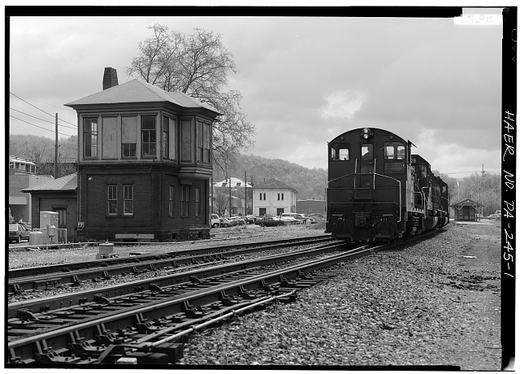
Hunt Tower, Fifth & Allegheny Streets, Huntingdon
Hunt Tower, Fifth & Allegheny Streets, HuntingdonLibrary of Congress, Historic American Buildings Survey / Historic American Engineering Record. No known copyright restrictions. pa2736

HUNT Tower stands just north of the tracks at the west end of the old station platforms in Huntingdon, where Fourth and Fifth Streets meet Allegheny. The Historic American Engineering Record recorded it as HAER PA-245, compiled by Nancy Shedd and Ken Heineman with editors Gray Fitzsimons and Kenneth Rose, part of a documentation project HAER and HABS began in February 1987 whose results were published in the 1991 county inventory.

The survey describes a two-story signal tower, 30 by 20 feet, with a brick first story, a frame second story and a hipped roof, plus a one-story addition of 10 by 10 feet. Tall windows wrap around the building, some of them covered with plywood when the surveyors visited. The survey credits both the Pennsylvania Railroad and the Huntingdon and Broad Top as builders.

The survey traces the building back to the flood of 1889. It explains that the flood destroyed the partly abandoned Juniata Division of the Pennsylvania Canal, and the Pennsylvania Railroad moved its tracks out of the middle of Allegheny Street and onto the canal bed, which in turn forced the Huntingdon and Broad Top to relocate its own tracks to the north bank of the river. The survey says that relocation was responsible for the switch tower, and dates HUNT Tower to about 1900.

Conrail abandoned the tower to automation in 1985. The survey lists its owner as Huntingdon Revitalization & Development, the town's Main Street organization, which saved it from demolition and was restoring it for adaptive use. The survey's history section is the same text as the one written for the Union Depot, whose record counts the tower as one of three buildings in the station complex; the two records share one narrative.

The 1991 county inventory prints Jet Lowe's photograph of the tower as its Photo 38, on the same page as his view of the station.

This relocation of the tracks was responsible for construction of the new switch tower.Library of Congress, Historic American Buildings Survey / Historic American Engineering Record, Hunt Tower, written data pages, HAER PA-245, Hunt Tower, data pages, report page 1, Significance (PDF p. 2) · character 1,213 of the scanned text
Checked against the record. Checked against the survey's written record before publication; 5 claims it did not support were removed or corrected.

Open this story on its own page →

Did you know? The man who helped bring the first national Native American rights organization into being spent the last fourteen years of his career teaching in Huntingdon. His story is more complicated than a post like this usually allows, so here is the whole of it.

Fayette Avery McKenzie was the first American sociologist to specialize in Indian affairs. He taught at the boarding school on the Wind River Indian Reservation in Wyoming. In April of 1911 he sent invitations, and six American Indian intellectuals came to a meeting at Ohio State University. Dr. Charles Eastman, Santee Dakota. Dr. Carlos Montezuma, Yavapai Apache. Thomas L. Sloan, Omaha. Charles Edwin Dagenett, Peoria. Laura Cornelius Kellogg, Oneida. Henry Standing Bear, Oglala Lakota. What came out of that meeting became the Society of American Indians, the first national rights organization run by Native people themselves. McKenzie pushed for it to be Native run, played down his own title, and worked in the background.

From 1915 to 1925 he was president of Fisk University. He won Fisk its academic recognition and raised a million dollar endowment. He was also forced out. He closed the student newspaper, abolished the student council and banned most extracurricular activities, and students who broke those rules were expelled. W. E. B. Du Bois wrote in The Crisis that no decent Negro should send a child to Fisk until McKenzie was gone. The students protested in 1924 and 1925 and he resigned. There is a scholarly literature on that strike.

He came to Juniata College in 1927, taught sociology, served two years as dean of men, opened the Altoona Center in 1928, and retired in 1941.

Both of those things are true about the same man, and leaving either one out makes him into somebody he was not.

Checked against the record. SUPERSEDES the batch 005 verdict on this story, with 8 quoted sources against 4. Batch 005 was right about what it caught and blind to something bigger. Six American Indian intellectuals founded it at a meeting McKenzie convened, and he deliberately kept himself out of the credit. He was FORCED OUT of Fisk. He closed the student newspaper, abolished the student council, banned most extracurricular activities, and stu…

Open this story on its own page →

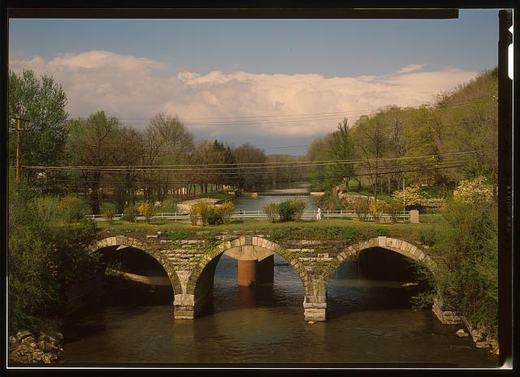
At the east end of Huntingdon, just south of the Penn Street road bridge, four semicircular stone arches stand over Standing Stone Creek with no rails on top of them. The top courses of stone are gone, and forsythia and small shrubs grow where the track used to be. This is the bridge the Pennsylvania Railroad built in 1848 and 1849 to carry its first single track through the county.

The nomination says contracts for the sections through Huntingdon were let in May 1848, and that regular service began the day after the first train reached the town in June 1850. Lytle's 1876 history describes the arrival: the first train of cars came in on a Thursday, five or six trucks drawn by the locomotive "Henry Clay," running slowly on a trial trip so that people had time to reach the line and watch. Africa's 1883 history adds that the papers of the day thought it wonderful progress that Philadelphia to Cincinnati could now be done in three days and six hours.

The bridge carried trains for just over forty years. In 1892 the railroad moved its main line onto the bed of the former Pennsylvania Canal, just south of the original alignment, and the old bridge was abandoned. Its replacement stands just to the south. The 1991 county engineering inventory records that the contract for the new bridge went to Brown Bros. and Sims in March 1891, that a large force of Hungarian laborers built it, and that the first trains ran over the new track in February 1892.

What remains is 110 feet long. The voussoirs and keystones of the arch rings are smooth faced, while the rest of the stonework is rock faced. The nomination, written in 1989 and drawing much of its text from Nancy Shedd's 1988 report for the Historic American Engineering Record, calls the bridge a good example of the railroad's early stone construction and notes that rail service mattered to local iron and flour industries. It was listed under the Industrial Resources of Huntingdon County multiple property nomination, and the county inventory describes it as one of the few original main line bridges of the Pennsylvania Railroad still standing. It sits about 30 feet from the road bridge and 50 feet from the later railroad bridge, each of its arches about 25 feet across.

The old Standing Stone Creek Bridge is a good example of a nineteenth century multiple span stone arch bridge built by the Pennsylvania Railroad for their right-of-way. With its good integrity it is a fine example of the early bridge construction used by the Pennsylvania Railroad.National Register of Historic Places nomination, Pennsylvania Railroad Old Bridge over Standing Stone Creek (reference 90000410), Pennsylvania Railroad Old Bridge over Standing Stone Creek, section 8 page 2 (PDF page 5) · character 5,284 of the scanned text
Checked against the record. Checked against the National Register nomination text before publication; 4 claims the nomination did not support were removed or corrected.

Sources

  1. National Register of Historic Places nomination: Pennsylvania Railroad Old Bridge over Standing Stone Creek, reference 90000410 (1989)
  2. Lytle, History of Huntingdon County (1876), pp. 149-150
  3. Africa, History of Huntingdon and Blair Counties (1883), Pennsylvania Railroad section
  4. Huntingdon County Historic Engineering and Industrial Sites Inventory (1991), Pennsylvania Railroad: Old Bridge over Stone Creek and Standing Stone Creek Bridge, pp. 78-81

Open this story on its own page →

Stone Creek Bridge II, South of Penn Street between First & Second Streets, Huntingdon
Stone Creek Bridge II, South of Penn Street between First & Second Streets, HuntingdonLibrary of Congress, Historic American Buildings Survey / Historic American Engineering Record. No known copyright restrictions. pa2738

Where the Pennsylvania Railroad's main line crosses Stone Creek at the eastern end of Huntingdon borough, south of Penn Street between First and Second Streets, a three-span stone arch bridge carried its first trains in February 1892. The Historic American Engineering Record documented it as Stone Creek Bridge II, HAER PA-247, at Conrail marker 201.88, compiled by Nancy Shedd and Ken Heineman with editors Gray Fitzsimons and Kenneth Rose. The record came out of a documentation project HAER and the Historic American Buildings Survey began in southwestern Pennsylvania in February 1987, and the county results were published in 1991.

The survey measures the bridge at 132 feet, three spans of rough-faced stone. It was built in 1891 and 1892 when the railroad moved its tracks through town from Allegheny Street to the bed of the defunct Pennsylvania Canal, and it replaced a stone arch bridge of 1849 just upstream, recorded separately as Stone Creek Bridge I. The contract went to Brown Brothers and Sims in March 1891, and the survey says the contractors used a large force of Hungarian laborers to finish the work. The survey describes a 12 foot extension of reinforced concrete covering the stonework on the north side, and it cites railroad records for a widening of the bridge in 1948 by a concrete section added to that side. A builder's plaque on the south face is no longer legible.

The survey drew on Conrail's list of undergrade and overhead structures, the Huntingdon County Historical Society's photograph collection, the 1891 Sanborn map, and two issues of the Huntingdon Semi-Weekly News, 19 March 1891 and 25 January 1892. Its owner in the survey was Conrail, and its use was still railroad bridge. An addendum sheet holds xerographic copies of color transparencies.

The National Register nomination for the older bridge, prepared in 1989, adds the earlier chapter: the Pennsylvania Railroad let the contracts for its sections through Huntingdon in May 1848, the first train reached Huntingdon on June 5, 1850, and the four-arch bridge of 1848 and 1849 was abandoned in 1892 when the main line moved to the canal bed. The 1991 county inventory measures the old bridge's four semicircular arches at about 25 feet each.

The contract for building this bridge was awarded in March 1891 to Brown Bros. and Sims, who used a large force of Hungarian laborers to complete the work. The first trains ran over the new track in February 1892.Library of Congress, Historic American Buildings Survey / Historic American Engineering Record, Stone Creek Bridge II, written data pages, HAER PA-247, Stone Creek Bridge II, data pages, report page 2 (PDF p. 3) · character 2,790 of the scanned text
Checked against the record. Checked against the survey's written record before publication; 4 claims it did not support were removed or corrected.

Open this story on its own page →

Did you know? Huntingdon tore down a courthouse people loved, and fifty five years later they were still sore about it.

The county's second courthouse went up in 1842 on the ground the present one stands on. The 1937 sesqui-centennial history describes it as "a beautiful colonial structure, with tall white columns across the front and a beautiful white colonial belfry." Then this, from the same page: "Unfortunately that beautiful building, which should have been preserved was torn down and the present one erected in 1882."

Here is how the replacement happened. A grand jury laid out what was wrong with the old building, including that "witness-rooms, jury-rooms, and convenient out-buildings are deemed a public necessity." The grand jury endorsed that report at the January sessions of 1882 and the court agreed.

Several plans came in. The commissioners chose one drawn by M. E. Beebe of Buffalo, New York. Six bids were opened, running from $71,300 up to $93,140.50, and the contract went to Henry Snare and Company at the lowest figure.

That June the county moved its offices into temporary quarters at the Morrison House, on the northeast corner of Third and Allegheny, and began pulling the old building down. By the twenty fourth of November the brickwork on the new courthouse had been carried almost to the top of the second story.

So the building on that corner today is the third one. The one before it had white columns, and at least one man in 1937 never got over losing it.

Which building in this county would you not want to lose? Tell us which one.

Checked against the record. Supersedes my own verdict from 09:50 TODAY, with a third source that turns a thin post into a good one. WHAT the check could not source this morning and still cannot: the 140-foot tower, the Statue of Justice, and "French Renaissance." All three remain cut. Four sources checked, none of them carries it. Still UNSOURCED, still not FALSE. What the new book did give: the 1937 Souvenir Historical Book, published for the …

Open this story on its own page →

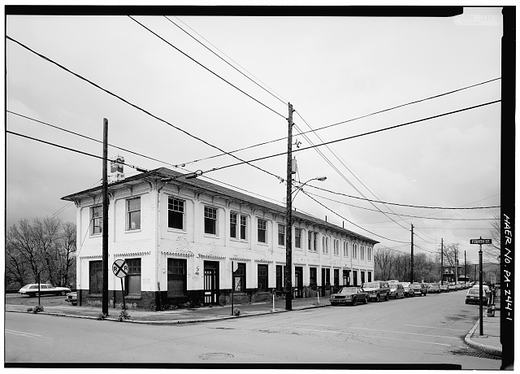
Huntingdon Station, Fourth & Allegheny Streets, Huntingdon
Huntingdon Station, Fourth & Allegheny Streets, HuntingdonLibrary of Congress, Historic American Buildings Survey / Historic American Engineering Record. No known copyright restrictions. pa2735

The Union Depot at Fourth and Allegheny Streets was built in 1872 to serve the Pennsylvania Railroad and the Huntingdon and Broad Top, which had each been using an existing building as a passenger station. The Historic American Engineering Record documented it as HAER PA-244, compiled by historians Nancy Shedd and Ken Heineman with editors Gray Fitzsimons and Kenneth Rose, part of a documentation project begun in February 1987 whose results were published in the 1991 county inventory.

The survey describes a two-story brick building 135 by 35 feet, with decorative brickwork at the eaves and in recessed panels around its openings, a hipped roof with bracketed eaves, and a stone foundation below grade. When it opened, the Pennsylvania's tracks ran down Allegheny Street, the canal passed south of the station on what is now the railroad right of way, and the depot faced the street, with a roof on iron columns sheltering the sidewalk and a conical-roofed tower on its northeast corner.

The flood of 1889 wrecked the partly abandoned Juniata Division of the canal, and the railroad moved its tracks off the street and onto the canal bed. The station was turned to face south in 1892, the street projections came off, and broad-roofed shelters went up over the new platforms. About 1905 a small enclosed eastbound shelter was built under the existing roof and a 25 foot addition went onto the west end. The survey says the depot closed in 1965.

The surveyors found the building abandoned but rich inside: wainscoting, a round cast-iron radiator, the oak freight-office counter, labeled mailboxes, early light switches, a tile-hearth fireplace upstairs and the original office corridor. They also recorded a leaking roof threatening all of it.

J. Simpson Africa's 1883 history adds an earlier depot a square to the east. It says Andrew Henderson, who served seven years as chief burgess of the borough, built the large brick house at the southeast corner of Allegheny and Third Streets that was long known as the Pennsylvania Railroad depot, before the depot moved a square farther west.

In Huntingdon, the tracks were removed from their hazardous location in the middle of a busy street and relaid on the canal bed.Library of Congress, Historic American Buildings Survey / Historic American Engineering Record, Huntingdon Station, written data pages, HAER PA-244, Huntingdon Station, data pages, report page 2 (PDF p. 3) · character 4,371 of the scanned text
Checked against the record. Checked against the survey's written record before publication; 4 claims it did not support were removed or corrected.

Open this story on its own page →

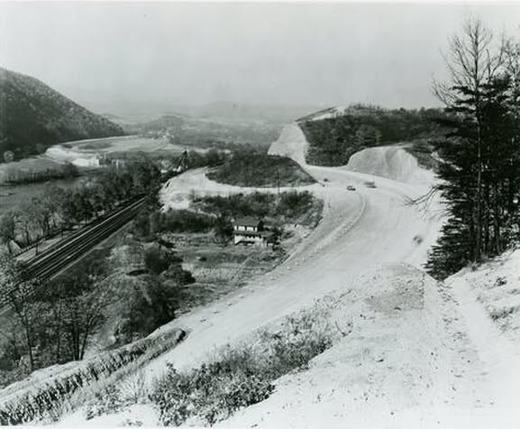
Cutting the Route 22 bypass near Smithfield, as Myer Souders describes it
Cutting the Route 22 bypass near Smithfield, as Myer Souders describes itShared by Myer Souders

Did you know? The stretch of Route 22 that runs past Huntingdon today was built in the late 1940s.

Federal bridge records date its bridges to 1948 and 1949: the bridge over Crooked Creek at Smithfield to 1948, and the bridge over Penn Street, the railroad and the Juniata River to 1949. A state highway history says construction began in 1949 on the new line from Route 26 to Penn Street south of Huntingdon, and the Huntingdon Daily News has its own negatives of the bypass being built, from about 1947.

Myer Souders sent us this photograph of the cut. He tells us it looks west toward Smithfield and Huntingdon, that the bypass went from start to finish between 1947 and 1949, and that the old highway ran on the south side of the railroad, next to the river, until it reached the farm by Numer's Hollow. And look at that house below the cut, just sitting there watching it all happen.

Checked and confirmed. CONFIRMED 2026-10-09 against the sources listed: every factual sentence was tied to a verbatim passage and a script confirmed each passage is in its source. Information shared with us by readers is given as theirs, not as fact: Myer Souders.

Open this story on its own page →

Did you know a Huntingdon man commanded the cavalry that stopped J.E.B. Stuart on the last day of Gettysburg?

David McMurtrie Gregg was born at Huntingdon on 10 April 1833. He went to West Point, graduated in 1855, was colonel of the Eighth Pennsylvania Cavalry by January 1862 and a brigadier general of volunteers by that November.

On the afternoon of 3 July 1863, while everyone was watching Pickett's Charge, Stuart tried to get around the Union right and into Meade's rear. The National Park Service puts the result plainly: cavalry under General David Gregg stopped him from turning the Federal flank and threatening that rear.

Gregg was outnumbered. McIntosh's and Custer's 3,200 men went at the Confederate horsemen from three sides. When it was over the Union had lost 254 men and the Confederates 450, and Stuart had got nowhere.

There is a monument on that ground called the Gregg Cavalry Shaft, put up in 1884. It is the only monument at Gettysburg that commemorates the cavalry of both sides.

Checked against the record. SOURCE UPGRADED from Wikipedia to two federal pages and one nineteenth-century biographical record, and the page gained more than it lost. CONFIRMED, from the Commemorative Biographical Encyclopedia of the Juniata Valley of 1897, which is in the project's own corpus: "David McMurtrie Gregg, born April 10, 1833, at Huntingdon; graduated at West Point, 1855 ... colonel Eighth Pennsylvania Cavalry in January, 1862; bri…

Open this story on its own page →

Did you know? Just before dawn on May 1, 1947, two sixteen foot sheets of steel shifted on an open gondola car of a westbound freight west of Huntingdon. Their ends swung out over the tracks on both sides.

The Pennsylvania Railroad's New York to St. Louis flyer, a sleeper and coach train called The American, was running westbound on the parallel track. It hit the steel, and the steel ripped open the side of the train.

Moments later an eastbound freight struck the steel sticking out on the other side. Its engine and tender came off the rails. All four main tracks of the Pennsylvania Railroad were tied up. Three trains, one obstruction, a few seconds apart.

Five people were dead by the next day. One of them was Jean Sims, twenty six years old, of Clifton, Virginia.

Her daughter Penelope was two weeks old. They pulled the baby out of the wreckage wrapped in a towel with her left leg broken, and she lived. The Associated Press found her a day later at J. C. Blair Memorial Hospital here in town, taking a bottle. Hospital attendants told the reporter she was pretty fussy after they set the leg.

Down the hall was Joseph Monaco, a railroad machinist from New Castle, critically hurt on the way home from a honeymoon that had started two weeks before. His bride Mary was hurt less badly. She told a reporter that all she wanted right then was to go home and take Joe with her.

Does anybody have family who was working at J. C.

Checked against the record. Confirmed: the date (May 1, 1947, before dawn); two 16-foot sheets of steel lying lengthwise on an open gondola of a WESTBOUND freight, which shifted so their ends stuck out over the tracks on both sides; the train struck was the Pennsylvania Railroad's New York to St. Louis sleeper-coach flyer, running westbound on the parallel track; the steel ripped open its side; and the THIRD-TRAIN claim, which is real. An eastb…

Open this story on its own page →

Behind Laney's Feed Mill on South 8th Street in Huntingdon, parallel to the railroad, stands a wooden warehouse 97 feet long and 35 feet wide. The Pennsylvania Railroad built it in 1863 for Lloyd and Henry on a narrow strip between the Pennsylvania Canal and the railroad, to transfer freight between canal boats and rail cars.

Africa's 1883 county history tells how the firm came to be. Samuel E. Henry drove a one horse cart on the old Portage Railroad as a youth in the early 1830s, then worked the canal as a boat driver, clerk and agent. In the spring of 1858 he and A. M. Lloyd went into the forwarding and commission business together at Hollidaysburg, where the railroad built them a warehouse and hired them to transfer everything that arrived by canal. The Huntingdon warehouse followed in 1863. The partners bought it from the railroad in 1865; that June Lloyd sold his interest to John G. Miller. By January 1, 1867 the firm was called Henry & Co. An 1870 photograph shows the lettering on the building: S.E. Henry & Co., forwarding and commission merchants, dealers in produce, fish, salt, coal, steel, iron and nails. John White, who worked for the firm from 1874 to 1880, described it as the largest and busiest warehouse on the canal, with up to forty men loading and unloading boats and cars at the wharf and siding.

After the Johnstown Flood of 1889 the railroad filled the flooded canal through Huntingdon and moved its main line onto the canal bed. That took Henry's ground, so he moved the warehouse about 450 feet, behind the Henry & Co. flouring mill, built in 1879. It was still in use as a warehouse when the nomination was written in 1989.

It was listed for its engineering, and the nomination says neither the move nor the later additions compromised its integrity as an example of framing built to carry exceptional loads. The first floor walls have 10 by 12 inch posts, diagonally braced. A row of 12 by 12 inch posts down the center carries a summer beam and 3 by 12 inch joists on 12 inch centers. The floors are laid double, one course across the joists and another diagonally beneath. Heavy timber trusses pinned with iron leave the second floor a clear span with no post in the way.

The timber structure is most nearly comparable in terms of size and loading requirements as those in the framing of barns.National Register of Historic Places nomination, Lloyd and Henry Warehouse (reference 90000397), Lloyd and Henry Warehouse, section 8 continuation (PDF page 6) · character 9,783 of the scanned text
Checked against the record. Checked against the National Register nomination text before publication; 6 claims the nomination did not support were removed or corrected.

Sources

  1. National Register of Historic Places nomination: Lloyd and Henry Warehouse, reference 90000397 (1989)
  2. J. Simpson Africa, History of Huntingdon and Blair Counties, Pennsylvania (1883), pp. 479-480, Henry & Co.
  3. Huntingdon County, Pennsylvania: An Inventory of Historic Engineering and Industrial Sites (HAER, 1991), Lloyd and Henry Warehouse entry

Open this story on its own page →

Did you know? The Huntingdon and Broad Top Mountain Railroad's report for 1857 records that turntables had been put in at Huntingdon and at Hopewell, along with the water stations needed on the route.

Myer Souders has a photograph of an H&BTM engine on the turntable which, he tells us, was taken at Smithfield between 1947 and 1949, looking northeast, with the Route 22 bridge over Fairground Road under construction.

The railroad did not run much longer. The Huntingdon and Broad Top closed in 1954, and a National Register study of the county's industries ties the closing directly to the decline of the coal industry.

Checked and confirmed. CONFIRMED 2026-10-03 against the sources listed: every factual sentence was tied to a verbatim passage and a script confirmed each passage is in its source. Where sources disagreed on a number, the number was left out. Information shared with us by readers is given as theirs, not as fact: Myer Souders.

Sources

  1. Huntingdon and Broad Top Mountain Railroad and Coal Company, Annual Report (1857)
  2. National Register of Historic Places: Industrial Resources of Huntingdon County, 1780-1939 (multiple property submission) (1990)
  3. Nancy S. Shedd, Huntingdon County, Pennsylvania: An Inventory of Historic Engineering and Industrial Sites (HABS/HAER, 1991)

Open this story on its own page →

Did you know? You can still drive a piece of the 1810s turnpike, and it still has the same potholes people complained about two hundred years ago.

The Huntingdon, Cambria and Indiana Turnpike Road Company was incorporated March 20, 1810, after attempts in 1806 and 1807 to get a turnpike from Harrisburg to Pittsburgh had failed. Then nothing happened for years. It took a meeting of citizens in the Huntingdon County Courthouse in January of 1814 to finally raise enough interest, and stock went on sale that April.

By 1821 the road ran complete from Huntingdon to Blairsville, seventy seven miles. It cost more than the subscribers had paid in, so the managers ended up issuing scrip to pay the contractors.

Here is the part worth knowing. A three and a half mile stretch of it still exists, crossing Warrior Ridge between Huntingdon and Alexandria. The state's survey of historic engineering sites calls it "extant and in relatively unaltered condition," mostly unpaved, steep and sharply curved, and "perennially marked by the potholes, ruts, washouts, and dust or mud of which eighteenth-century travelers complained."

East of the ridge it runs past the Pulpit Rocks.

Two centuries on, the road is still bad in exactly the way the people who used it said it was.

Have you driven that stretch over Warrior Ridge? Tell us what it is like now.

Checked against the record. Error: "The road was completed by 1819." It was not. The 1991 county survey of historic engineering and industrial sites says "By 1821 the road was complete from Huntingdon to Blairsville, a distance of seventy-seven miles," and gives the construction date range as 1815 to 1821. Two years early. Correct in the original: the 1810 authorization (the company was incorporated March 20, 1810), the seventy seven miles, and…

Open this story on its own page →

Did you know? In 1932 Nancy Slaughter Lee became the first African American student to graduate from Juniata College, and she did it in her own hometown.

She was a Huntingdon native and a graduate of Huntingdon High School, the daughter of Levi and Anna Bertha Slaughter. She enrolled at Juniata after finishing high school in 1928, and she was part of the Day Students' Club all four years she was there.

Her senior portrait in the 1932 Alfarata is the first image of a Black student to appear in any Juniata yearbook.

Juniata College spent this past February telling her story week by week out of its own archives, and it is worth following.

Checked against the record. CONFIRMED by the college itself, which is the institution that holds the records: Nancy (Slaughter) Lee was the first African American student to graduate from Juniata College, in 1932. She was a Huntingdon native and a graduate of Huntingdon High School, the daughter of Levi and Anna Bertha Slaughter, enrolled after finishing high school in 1928, and was part of the Day Students' Club all four years. Her senior port…

Open this story on its own page →

Did you know? A two time Caldecott Medal winner was born right here in Huntingdon.

Chris Raschka was born in Huntingdon on March 6, 1959. The Library of Congress has it in his authority record, which is about as official as a birth fact gets.

He won the Caldecott Medal twice, for The Hello, Goodbye Window in 2006 and for A Ball for Daisy in 2012. Before either of those, Yo! Yes? was named a Caldecott Honor Book in 1994. The Caldecott is the top award in American children's illustration, and most illustrators never get near it once.

Being straight about the rest of it: he did not grow up here. His family moved to suburban Chicago, and he spent part of his childhood in Austria, where his mother was from. Huntingdon is where he started, not where he was raised.

Still, somewhere in this town there is a hospital record with a future two time Caldecott winner on it, dated March 6, 1959.

Checked against the record. The blocking item was the 1959 birth year, which Wikipedia does not carry. The library of congress name authority file does, and it is a better source than anything else in this story's chain: record n90644672 gives 'Raschka, Christopher, $d1959-' and a birthDate of 1959-03-06, with LC's own note reading 'Chris Raschka (born March 6, 1959 in Huntingdon, Pennsylvania)'. The post's year was right and the rewrite can no…

Open this story on its own page →

The Huntingdon County Library has been a free door for generations, and it is at 330 Penn Street.

It is more than shelves. There is a makerspace you can book studio time in. There is Library by Mail, which posts books to people who cannot get in to the building. There is Ask A Librarian, if the question is bigger than a search box. If they do not have the book, interlibrary loan will go and find it somewhere else in the state, and Power Library puts a great deal more on your screen at home. You can even register to vote there.

A town with a good library is a town that believes in its own future.

Walk in this week. Get a card.

Checked against the record. SERVICES REPLACED WITH THE ONES THE LIBRARY ACTUALLY NAMES. This page listed things the library was assumed to offer rather than things it says it offers. Describing a service that does not exist creates a promise nobody has agreed to keep, and it is the same error as inventing a fact. WHAT THE LIBRARY'S OWN SITE NAMES, and what this page now carries: Summer Programs, Library by Mail, Ask A Librarian, makerspace stu…

Open this story on its own page →

Did you know? The keyboard player on those Mannheim Steamroller records was born in Huntingdon.

Jackson Berkey was born here on May 24, 1942. He took a master's in piano performance at Juilliard, studying in the studio of Josef Raieff, and had sessions with Vincent Persichetti and William Schuman. He made his Town Hall debut in New York in 1969. In 2009 Steinway named him a Steinway Artist.

His own catalog describes him as featured keyboardist with Mannheim Steamroller. It also lists over four hundred published titles of his own writing: choral and vocal works, chamber and instrumental pieces, band and orchestral writing, concerti, and works for chorus and orchestra.

So the man at those keyboards has several hundred pieces of his own out in the world under his own name.

Checked against the record. Five numbers and one role claim removed. This post was almost entirely numbers, and almost none of them held up. 1. "co-founded" is CONTESTED and is removed. Wikipedia says "co-founded with Chip Davis in 1974," citing an Omaha World-Herald piece the check could not open. Berkey's OWN official site does not claim it. It calls him "featured keyboardist with Mannheim Steamroller." When a man's own site gives him a small…

Open this story on its own page →

The Huntingdon Borough Historic District takes in 521 buildings at the southern end of the borough, bounded roughly by Allegheny, Ninth, Moore and Second Streets. The buildings date from the late eighteenth century to the first decades of the twentieth, and are typically detached, two and three story, brick and frame structures. The nomination was prepared in July 1985 by George J. Drobnock, Rory Peachey and Nancy S. Shedd of Huntingdon Revitalization & Dev., Inc. The district had already been recorded in the Huntingdon County Historic Sites Survey of 1980.

The town began as a proprietary town in 1766, when William Smith, first head of the College of Philadelphia, acquired the site. He laid out lots in 1767 and set aside a market space on Smith Street, the broad center street near the river. In 1787 the town was made the seat of the new county. In the early 1790s, after a small jail on Lot 41 burned, Smith and the trustees of the public buildings agreed on a plan: a courthouse in the middle of Smith Street, facing a jail later built on the north side of Mifflin Street. A market square, the Diamond, was then established in 1792 along Penn Street two blocks west. Africa's 1883 county history records that Smith Street, now Third, was originally ninety feet wide, and that the old courthouse was demolished in May 1848, when the street was reopened to its full width. The nomination says the spot is marked by a garden plot and a monument erected in 1896.

Growth came with the transportation routes. The Huntingdon, Cambria and Indiana Turnpike was completed in 1820, the Pennsylvania Canal reached town in 1832, and the main line of the Pennsylvania Railroad arrived in 1850. Eight to ten hostelries were built for travelers; the nomination names the Penn Hunt Hotel, the former Leister House of 1873 to 1874, as the one still standing. More than fifty businesses were established between 1850 and 1900. Almost three quarters of the district's buildings went up between 1825 and 1900, and brick accounts for sixty percent of the buildings in the district.

The district was listed for architecture and commerce, with a period of significance of 1788 to 1935. The nomination calls it the largest commercial center in the county. Two blocks north on Third Street, the county jail of 1829 was still in use as part of the county's jail in 1985.

Between 1865 and 1875 businessmen constructed no less than eighteen tall (principally three story) commercial buildings which fronted directly on the street, often with projecting cornices and window moldings which accentuated their different character. Every one of these buildings survives todayNational Register of Historic Places nomination, Huntingdon Borough Historic District (reference 86000852), 86000852, section 8 continuation, p6 · character 15,202 of the scanned text
Checked against the record. Checked against the National Register nomination text before publication; 7 claims the nomination did not support were removed or corrected.

Sources

  1. National Register of Historic Places nomination: Huntingdon Borough Historic District, reference 86000852 (1985)
  2. J. Simpson Africa, History of Huntingdon and Blair Counties, Pennsylvania (Huntingdon Borough, Court-Houses, pp. 49-50) (1883)

Open this story on its own page →

Did you know? We shared a while back that Huntingdon was named for an English town and not for a countess. A reader sent us back to the books. The reader was right and we were wrong.

Rev. William Smith had the town laid out in 1767 and gave it the name Huntingdon in honor of Selina, Countess of Huntingdon, in England, who had been a large donor to the College of Philadelphia, later the University of Pennsylvania, where Smith was then provost.

The 1883 county history states it carefully. It says the name is believed to have been given by Dr. Smith in her honor, in grateful remembrance of her donation. The 1909 Historic Huntingdon states it outright, and prints her portrait at the front of the book, under the line that both borough and county are named in her honor.

So the countess story stands, and it stands on books that have been on shelves in this county the whole time.

Thank you to whoever sent us back to check.

Checked against the record. CORRECTED. Two of its supporting claims did not survive that scrutiny. Confirmed: Smith had the town laid out in 1767 and named it for Selina, Countess of Huntingdon, who had donated to the College of Philadelphia where Smith was provost. The substance of the correction is right. A specific attribution to a named relative is exactly the sort of detail a reader will ask about, and it is the riskiest kind of claim to c…

Read the full story, with 3 passages quoted from the county histories →

Did you know the Pulpit Rocks northwest of Huntingdon are a National Historic Landmark, and that what happened there was an idea?

They stand on Warrior Ridge, about a mile and a half out of town along the old Huntingdon and Hollidaysburg Turnpike. Weathered pillars of Oriskany sandstone, fifty feet high, with passages between them anywhere from one to ten feet wide. The rock was laid down roughly 390 million years ago, when this was the floor of an inland sea.

Pennsylvania set up its Geological Survey in 1836 and this was among the first ground it covered. Henry D. Rogers, the state's first geologist, and his two assistants James C. Booth and John F. Frazer, worked out here that the accepted wisdom was wrong. Everyone believed a single sandstone ran under the ridges. At the Pulpit Rocks it was plain there were three ridge-forming sandstones, with thick beds of other rock between them.

That correction is where structural geology starts. When Rogers published his final report in 1858, George Lehman's watercolour of these rocks was the frontispiece, and Lehman is commonly held to be the first professional artist a state or federal survey ever hired to draw its sites.

The site was designated a National Historic Landmark on 4 November 1993. The major section belongs to Juniata College, given by the Africa family, and the college's geology department still teaches there.

Checked against the record. SOURCE UPGRADED. This story previously rested on Wikipedia alone. It now rests on the National Historic Landmark nomination itself (NRHP ref. 93001614), plus I. C. White's 1885 report for the Second Geological Survey, which is in the project corpus. CREDIT CORRECTED. The original gave the discovery to John Frazer alone. The nomination gives it to three men: the rocks 'profoundly represent an understanding achieved b…

Open this story on its own page →

Did you know? After Huntingdon stopped building railroad cars, the old car works went on to make radiators.

W. A. Orbison and C. W. Welch started the Huntingdon Car Works in 1872 to build freight cars, and Blain Brothers bought and enlarged it in 1880. By 1901 the buildings were vacant. A series of industries moved in. The Keystone Boiler Works lasted less than five years and the Atlantic Radiator Company less than ten. They were followed by Pierce, Butler and Pierce Manufacturing Company, another radiator maker, which continued until the 1940s. A county souvenir book printed in 1937 says the plant was then making high grade hot water radiators.

Pam Kane tells us her house is still heated with radiators built at the Huntingdon Radiator Works.

Checked and confirmed. CONFIRMED 2026-10-03 against the sources listed: every factual sentence was tied to a verbatim passage and a script confirmed each passage is in its source. Where sources disagreed on a number, the number was left out. Information shared with us by readers is given as theirs, not as fact: Myer Souders | Pam Kane.

Open this story on its own page →

Did you know? When Huntingdon's first courthouse went up on Third Street, the man who laid out the town paid for its bell himself.

Dr. William Smith bought it from the Philadelphia bell founder Samuel Parker and presented it to the borough. The receipt survives, dated April 5, 1798. The bell carried his name cast right into it: "Cast by Samuel Parker, Philada., 1798. William Smith, D. D., to the borough of Huntingdon, Juniata."

That bell called the county to court for decades. And when the old Third Street courthouse finally came down, the town did not scrap it. They lifted it into the cupola of the school house, and it went right on ringing, calling children in to learn instead of calling men in to be judged.

It rang until a frosty morning, December 12, 1861, when it cracked while calling the schools.

The founder's bell spent its whole life calling this town to something better.

Checked against the record. It was based only on the original's own cited web page (an isolated 1794 spec) and I called the original false before checking the deep county sources. The two standard county histories confirm nearly all of it. (1) 'Middle of Third Street' is RIGHT: Africa 1883 says 'Third, then called Smith Street,' which reconciles the 1794 document's 'middle of Smith St.' (2) 1797 is RIGHT: the 1909 history says 'the probability,…

Read the full story, with 3 passages quoted from the county histories →

Did you know a Nobel Prize in Physics has a Huntingdon County college behind it, and not for one generation but three?

William D. Phillips shared the 1997 Nobel Prize in Physics with Steven Chu and Claude Cohen-Tannoudji, a third each, for developing methods to cool and trap atoms with laser light.

He started at Juniata College in the autumn of 1966. His mother and father had both been there before him, the first in their families to go to college at all, graduating in 1930 and 1936. They had never met. A Juniata professor who knew them both suggested to his father that he might call a young Juniata alumna and ask her out.

His Aunt Betty went to Juniata. So did his sister. So, later, did his younger brother Tom.

Phillips graduated in 1970, in what he called a hectic few weeks in which he and Jane graduated from their respective colleges, married, honeymooned and moved to Boston for MIT. Twenty-seven years later he was in Stockholm.

Checked against the record. SOURCE UPGRADED from Wikipedia to two primary records: the Nobel Foundation's own API for the prize, and Phillips's autobiography published by the Nobel Foundation for everything about Juniata. CONFIRMED at the Nobel Foundation: the 1997 Nobel Prize in Physics, awarded to Steven Chu, Claude Cohen-Tannoudji and William D. Phillips, one third each, with the citation "for development of methods to cool and trap atoms w…

Open this story on its own page →

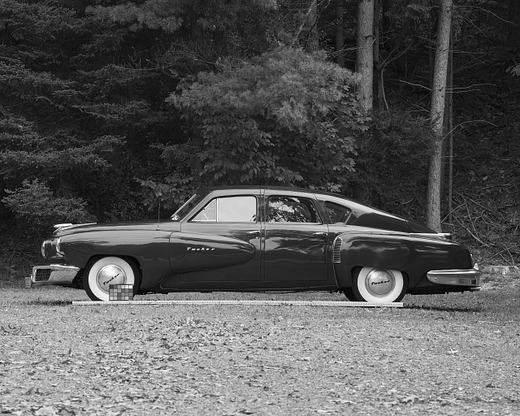
1947 Tucker '48 Prototype, Huntingdon
1947 Tucker '48 Prototype, HuntingdonLibrary of Congress, Historic American Buildings Survey / Historic American Engineering Record. No known copyright restrictions. pa4156

The maroon fastback on the floor of the William E. Swigart, Jr. Automobile Museum at 12031 William Penn Highway, Huntingdon, is the first automobile the Tucker Corporation ever built. The Historic American Engineering Record documented it as HAER PA-652. Its measurements date from October 2014, and its written history was prepared by Casey T. Maxon of the Historic Vehicle Association, with help from Preston T. Rose and historian John Tucker, and carries dates through December 2020.

The survey says the car was built between January and June 1947 at the Tucker plant in Chicago. Metal shaper Herman Ringling and his team formed the steel body from renderings by stylist Alex Tremulis, using a 1942 Oldsmobile as a donor for sheet metal, parts and frame members. Tremulis named it the Tin Goose for its all steel body and the heavy lead solder used to smooth the panels. Hours before its unveiling in June 1947 the aluminum suspension arms broke under the car's weight and mechanics built a new set from copper; the fuel injection could not be set up, so the engine ran on a carburetor and barely idled. It was driven onto the stage anyway, before more than 3,000 people.

It went on to Washington, New York, Los Angeles and Chicago for display and press events in 1947 while the Securities and Exchange Commission scrutinized the company's stock offering. The survey counts thirty-seven cars built before the plant closed and fifty-one Tucker automobiles completed in all, and Preston Tucker and seven associates were cleared of all charges on January 22, 1950. The Tin Goose was sold at the liquidation auction in October 1950, later sat on blocks on Lester Schaefer's property in Steelton, and was bought by John Lemmo of Peninsula, Ohio, in the early 1970s and restored by 1984. William E. Swigart, Jr. bought it at a Kruse auction in Auburn, Indiana, in August 1998 for $250,000.

The survey found the car no longer carries its original 589 cubic inch engine; by the SEC investigation of 1948 it had the 335 cubic inch engine, adapted from a Franklin helicopter engine, that went into the production cars. In 2018 students and faculty at the Pennsylvania College of Technology rebuilt its brakes and fuel system before it was shown at Pebble Beach that August. Weighed on racing scales on October 13, 2014, it came to 4,306 pounds.

The Tin Goose got its name from Tremulis due to its all steel body construction and heavy application of lead solder to smooth out the panels.Library of Congress, Historic American Buildings Survey / Historic American Engineering Record, 1947 Tucker '48 Prototype, written data pages, HAER PA-652 data pages, page 6 · character 10,975 of the scanned text
Checked against the record. Checked against the survey's written record before publication; 6 claims it did not support were removed or corrected.

Open this story on its own page →

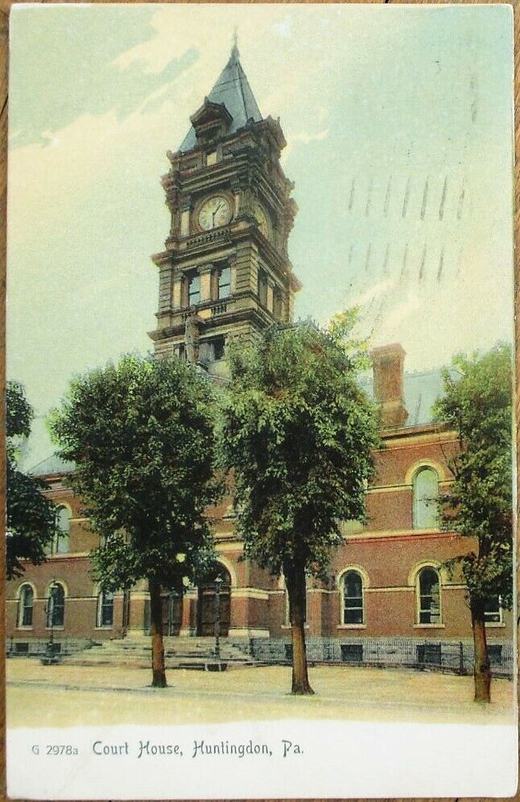
The Huntingdon County courthouse in 1905, the building the grand jury's report of 1882 led to.
The Huntingdon County courthouse in 1905, the building the grand jury's report of 1882 led to.Unknown authorUnknown author stg09

Did you know? The courthouse in Huntingdon exists because a grand jury said the old one was unfit, and the county then took the cheapest bid on the table.

A grand jury report laid out what was wrong with the old building, including that "witness-rooms, jury-rooms, and convenient out-buildings are deemed a public necessity." The grand jury endorsed the report at January sessions, 1882, and the court agreed.

Several plans came in. The commissioners picked one drawn by M. E. Beebe of Buffalo, New York. Six bids came in at the letting, running from $71,300 all the way up to $93,140.50, and the contract went to Henry Snare and Company at the low figure.

In June the county moved its offices into temporary quarters at the Morrison House, on the northeast corner of Third and Allegheny, and started tearing the old building down. By the twenty fourth of November the brickwork on the new courthouse had been carried almost to the top of the second story.

That building is still standing on that corner today.

What is the building in this county you would most hate to lose? Tell us which one.

Checked against the record. The original asserted a 140-foot tower, a Statue of Justice on top of it, and the French Renaissance style. Its last word on the subject is the brickwork reaching the second story. The 1909 Historic Huntingdon returned nothing on a new courthouse. SAH Archipedia is 403 to direct fetch. So: UNSOURCED, not false. Also cut: "has dominated the town skyline for nearly 145 years." 1883 to 2026 is 143 years, and "nearly 145…

Read the full story, with 3 passages quoted from the county histories →

Did you know? The log jail Huntingdon County built on lot No. 41 burned with a prisoner inside.

On August 25, 1791, under the agreement that made Huntingdon the county seat, Dr. Smith conveyed lot No. 41 to trustees as a site for a county prison. A log jail was put up on it. After standing some years it was destroyed by fire. There was a prisoner in it at the time whom it was impossible to rescue, and he was burned with the building.

The lot was on the east side of what is now Second Street, directly opposite the end of Penn Street. When the turnpike was made through Huntingdon it passed over the lot. The next jail was a small stone building on what is now Third Street.

Checked and confirmed. CONFIRMED 2026-10-03 against the sources listed: every factual sentence was tied to a verbatim passage and a script confirmed each passage is in its source. Where sources disagreed on a number, the number was left out.

Sources

  1. Milton Scott Lytle, History of Huntingdon County (1876)

Open this story on its own page →

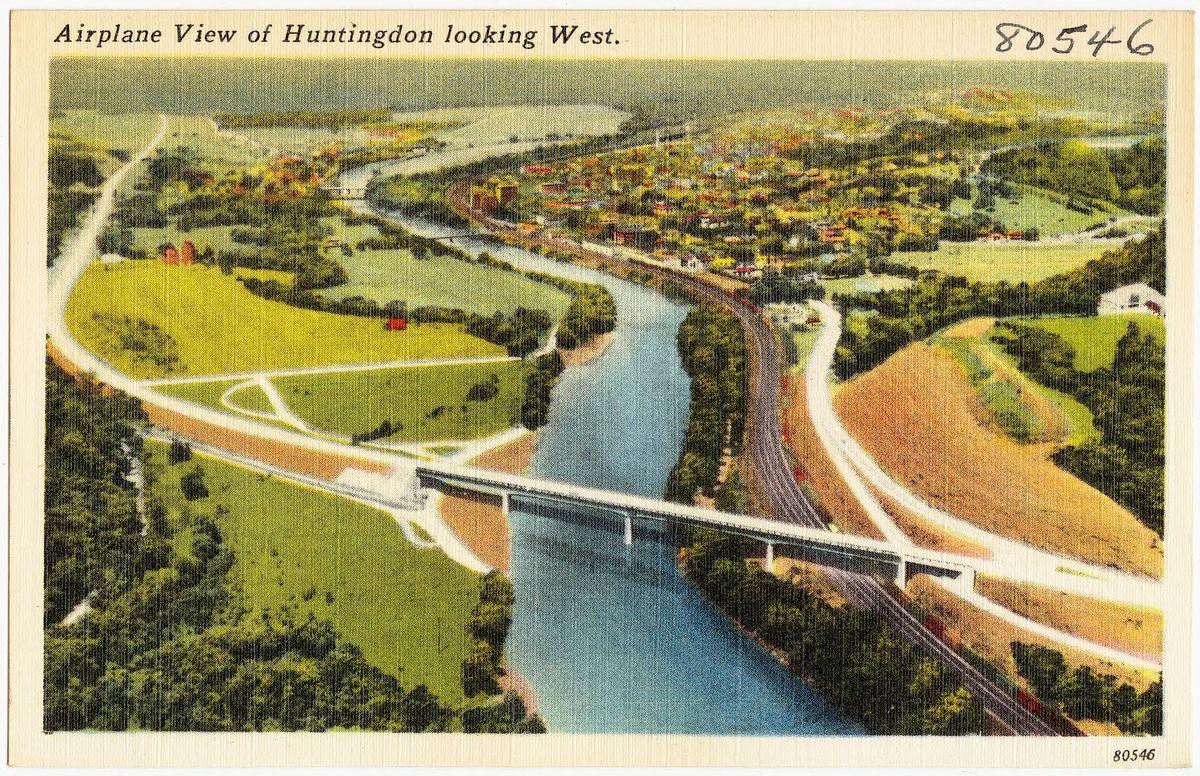
Airplane view of Huntingdon looking west, a linen-texture postcard published by W. A. Grimison and Son of Huntingdon, between about 1930 and about 1945
Airplane view of Huntingdon looking west, a linen-texture postcard published by W. A. Grimison and Son of Huntingdon, between about 1930 and about 1945Boston Public Library, Tichnor Brothers collection no. 80546. Published by W. A. Grimison and Son, Huntingdon, Pennsylvania. Public domain, via Wikimedia Commons. Tichnor Brothers collection 80546

A postcard photographer went up over Huntingdon and shot the borough looking west, with the Juniata and its bridges running away below. It was published in the town itself, by W. A. Grimison and Son, and printed on the linen stock that gives postcards of this period their texture. The Boston Public Library, which holds it in the Tichnor Brothers collection, dates it no more precisely than between about 1930 and about 1945, and that is as far as this page will put it either.

Checked against the record. The photograph's own record places it in Pennsylvania, Huntingdon county, Huntingdon, and names the Huntingdon publisher who issued it. The date is the library's own hedge, quoted rather than narrowed.

Open this story on its own page →

Did you know? The world's largest operating steam locomotive crossed Huntingdon County this summer.

Union Pacific's Big Boy 4014 came through on Wednesday, July 8, on its east coast tour celebrating America250. The Huntingdon Daily News reported that it passed through Mount Union, Mapleton, Mill Creek and Huntingdon, where it stopped for about 10 minutes. From there it went on through Spruce Creek and then on to Tyrone. Hundreds of spectators lined the route.

Checked and confirmed. CONFIRMED 2026-10-03 against the sources listed: every factual sentence was tied to a verbatim passage and a script confirmed each passage is in its source. Where sources disagreed on a number, the number was left out. Information shared with us by readers is given as theirs, not as fact: Lynn Klingel.

Open this story on its own page →

Did you know? Huntingdon sent the same man to Congress for twenty two years, and he never came home from the job.

Richard Murray Simpson was born in Huntingdon on August 30, 1900. He entered the U.S. House on May 11, 1937 and served without a break until January 7, 1960. In 1953 he became chair of the National Republican Congressional Committee, and at the time of his death he was the ranking member of the Ways and Means Committee, which is about as much leverage as a member of the House can hold.

He died in office on January 7, 1960, at Bethesda Naval Medical Center, several weeks after brain surgery.

Twenty two years, and the last day of them was his last day.

Checked against the record. CORRECTED on arithmetic and on a missed fact that is better than anything in the original. Arithmetic: the original says '23 years straight' and '1937-1960'. May 11 1937 to January 7 1960 is 22 years and about 8 months. Rounding up to 23 is an overstatement of a checkable number, so the rewrite says twenty two. Name corrected: it was the NATIONAL Republican Congressional Committee, which he chaired from 1953. Sharpen…

Open this story on its own page →

Did you know? Horace Porter was born in Huntingdon on 15 April 1837, and he has a Medal of Honor.

He earned it at Chickamauga on 20 September 1863, as a captain in the Ordnance Department. The official citation is nine lines and worth reading whole: “While acting as a volunteer aide, at a critical moment when the lines were broken, rallied enough fugitives to hold the ground under heavy fire long enough to effect the escape of wagon trains and batteries.”

He did not receive it for another thirty-nine years. The medal was presented on 8 July 1902, when Porter was sixty-five and serving as the United States ambassador to France.

In between he had been personal secretary to President Ulysses S. Grant, and he rose to brevet brigadier general. He died in New York in 1921. His Medal of Honor is still in existence, held in Special Collections at the Georgetown University Libraries.

Checked against the record. SOURCE UPGRADED from Wikipedia to the official recipient record, and everything the page already claimed survives. CONFIRMED: born 15 April 1837 at Huntingdon, Huntingdon County, Pennsylvania; Medal of Honor for action at Chickamauga, Georgia on 20 September 1863; the action itself, rallying broken troops under fire. The record gives the citation verbatim, so the page now quotes it instead of paraphrasing, and the p…

Read the full story, with 1 passage quoted from the county histories →

Did you know? Huntingdon once built railroad cars, and the best part of the story is that the works had already failed once.

In 1872 Orbison and Welch opened the Huntingdon Car Works at the northwest edge of the borough, turning out two or three freight cars a day. They bought their wheels from somewhere else. After about two years, operations were suspended. The place went quiet.

Then in July of 1880 two brothers, J. G. and M. C. Blain, bought the dead plant. They enlarged it to four times its old capacity and built their own foundries so they could finally cast their own car wheels, which is how it became the Car and Car Wheel Works.

By the time the county history was written it covered ten acres and ran on a two hundred and fifty horsepower steam engine. Four hundred men worked there. The payroll was fourteen thousand dollars a month. They went through ten thousand tons of iron and ten million feet of lumber a year, cut at their own mills in this county and dried on the property.

Two brothers bought a shut down factory and turned it into the biggest employer in town.

Checked against the record. Africa 1883 gives the whole arc: 'In 1872, W. A. Orbison and C. W. Welch, under the firm-name of Orbison & Welch, established... the Huntingdon Car-Works... at the end of which time operations were suspended.' Then: 'In July of 1880, J. G. and M. C. Blain, under the firm-name of Blain Brothers, purchased the establishment, which they enlarged to four times its previous capacity, and added an extensive foundry for cas…

Open this story on its own page →

Did you know? When Pennsylvania opened the Juniata canal, the boat that did it started from Huntingdon.

On November 27, 1832, the packet boat John Blair ran from Huntingdon up to Hollidaysburg, and that run officially opened the Juniata Division to traffic. The division climbed 584 feet across the 127 miles between Duncan's Island on the Susquehanna and Hollidaysburg.

The canal survey is candid about how it was built. Only four of the locks on this division were solid cut stone. Seven were rubble stone laid in mortar. The remaining seventy seven were wooden frames, planked watertight with boards four inches thick, held up by dry masonry and packed at the ends with mud and clay to keep the water in.

And it did not work right away. The record says that after the opening "it was subsequently discovered that some of the workmanship along that section was faulty and certain locks and several of the aqueducts had to be rebuilt before full operation was possible the following year."

So the famous first run out of Huntingdon was a ribbon cutting. The canal itself needed another year of repairs before it could really do the job.

Tell us the spot.

Checked against the record. Three of four numbers held. One was dropped, and it was dropped because the source fights with itself. The American Canal Society's Juniata Division index sheet says in its narrative: "The Juniata Division required 88 locks to overcome a change in elevation of 584 feet in the 127 miles between Duncan's Island and Hollidaysburg." That is where the original post's three numbers come from and 584 feet and 127 miles are …

Read the full story, with 3 passages quoted from the county histories →

Did you know the oldest American photograph still in existence was made by a man from Huntingdon, with a cigar box?

Joseph Saxton was born here in 1799. At eighteen he was apprenticed to David Newingham, a Huntingdon silversmith, watchmaker and engraver. When he set off for Philadelphia he carried a letter from his neighbour John McCahan, who published the Huntingdon Gazette, saying he was a lad of good character and very ingenious.

Daguerre's process reached America in print in the autumn of 1839. Saxton read the accounts, improvised a camera out of a cigar box and an ordinary reading glass, and on 16 October 1839 took a picture with it from a second-storey window of the Mint, where he worked. It caught Philadelphia's first Central High School and the State Armory.

The Smithsonian's study of him calls that plate perhaps the earliest daguerreotype ever taken in the United States, and says it certainly is the oldest American daguerreotype still in existence. It is held by the Historical Society of Pennsylvania.

He spent the rest of his working life in government service: machinery at the Mint, then curator of weights and measures, then from 1843 until his death in 1873 superintendent of weights and measures for the United States Coast Survey.

Checked against the record. SOURCE UPGRADED from Wikipedia to the Smithsonian's own published study of Saxton, by Arthur H. Frazier, 1975. The page was already careful and its central claim survived; three things changed. AGE CORRECTED, or rather un-asserted. The page said he "went to work at twelve as an apprentice to a watchmaker." Frazier says: "When he was eighteen years old, Saxton was serving an apprenticeship under David Newingham, a lo…

Read the full story, with 1 passage quoted from the county histories →

Did you know? Huntingdon once turned out paper tablets by the trainload, and it started with one man selling stationery on Penn Street.

In 1869 J. C. Blair opened a small retail stationery trade on Penn Street, between Fourth and Fifth. He did well enough that he stopped buying the goods he sold and started manufacturing them himself.

By the time the county history was written in 1883, one hundred skilled workers were on the floor, and the history says the only limit on the business was what those hands and his machinery could do in a day. Two years earlier, in 1881, Blair had bought the old Presbyterian Church building at Penn and Sixth, fitted it up as a factory, and christened it the Keystone Building. Fifty feet by seventy, four stories.

A man bought a church and filled it with tablet machinery.

Does anybody still have a J. C.

Checked against the record. CORRECTED. CONFIRMED from Africa 1883: J. C. Blair began as a small retail stationery trade on Penn Street between Fourth and Fifth in 1869, moved into manufacturing what he sold, employed one hundred skilled workers by 1883, and in 1881 bought the Presbyterian Church building at Penn and Sixth and converted it into a factory he named the Keystone Building, fifty by seventy feet and four stories. Africa's telephone l…

Read the full story, with 3 passages quoted from the county histories →

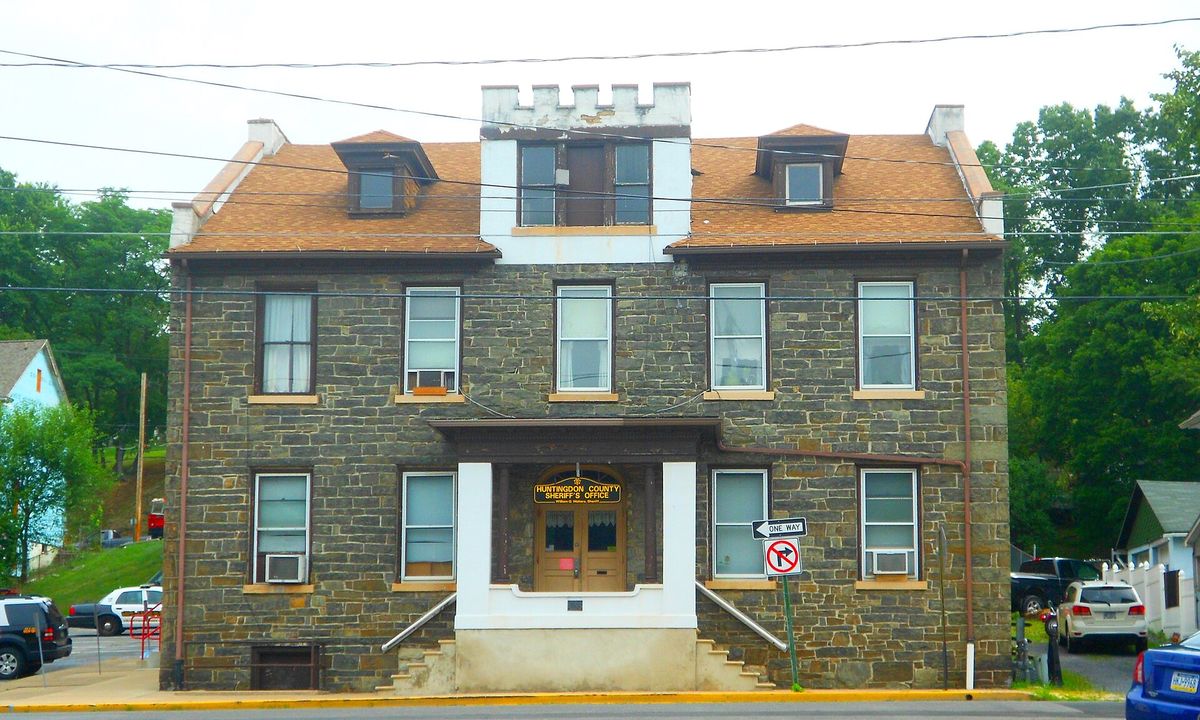
Huntingdon County Sheriff's Office and Jail, in the Huntingdon Historic District, Huntingdon, Huntingdon County, Pennsylvania
Huntingdon County Sheriff's Office and Jail, in the Huntingdon Historic District, Huntingdon, Huntingdon County, PennsylvaniaPhotograph by the Wikimedia Commons contributor Smallbones, 2016. Released under CC0, a public domain dedication. Huntingdon Co PA Shieriff's Office.jpg

The county sheriff's office and jail stand inside the Huntingdon Historic District, which is listed on the National Register of Historic Places. The photograph was taken in July 2016 and released by its photographer into the public domain outright.

Checked against the record. The photographer's own description names Huntingdon, Huntingdon County, Pennsylvania and the historic district, which is what places the subject. The file has no coordinates, so the description is the evidence rather than a geocoded point.

Open this story on its own page →

On Standing Stone Avenue, on a sloped site along PA Route 26 near the edge of Huntingdon Borough, with Standing Stone Creek at the back of the lot, stands a one story yellow brick armory in the Moderne style. The National Register nomination, prepared by an intern at the Pennsylvania Historical and Museum Commission in August 1989, describes a T plan building eight bays by three, with a running bond yellow brick veneer over structural tile walls on a concrete foundation. Flat roofs are ringed by parapet walls with small crenellations and stone coping. Four double door entrances are spaced evenly across the front, and the windows are metal casements.

The building went up in two stages. The administration section dates from 1930, when it was built for the 109th Motor Transport Company of the Pennsylvania National Guard. The drill hall beside it followed in 1937, funded in part by federal economic recovery programs. The full basement held a classroom, a locker room, a kitchen and a garage; the first floor held offices and the drill hall.

The architect was Joseph F. Kuntz of Pittsburgh, credited in the nomination with the design of at least eighteen armories in the western third of Pennsylvania. Kuntz began designing armories with the W. G. Wilkins Company just after the State Armory Board was created in 1905 and continued until 1930. Lutz Construction Company and Norman Hulme are also named on the form. The property covers 7.4 acres, its boundaries set out in Huntingdon County Deed Book D, Number 7, Page 80.

The armory was listed under Criteria A and C, for military and architecture, at the statewide level, as a member of the State Armory Building property type in the Pennsylvania National Guard Armories multiple property nomination. The nomination counts it as one of at least 37 T plan armories in Pennsylvania, and the cover sheet filed with it lists twenty armories from Bellefonte to York, Huntingdon eighth among them. In 1989 the state still owned the building and still used it for arms storage. The exterior and interior kept most of their original features, including windows and doors. One original garage door had been removed and the opening reduced for small metal doors, and the old garage had been reduced in size to make room for a day room, a classroom and storage.

It was built for the 109th Motor Transport Company of the Pennsylvania National Guard in 1930. It is one of at least 37 armories having a T plan type in Pennsylvania.National Register of Historic Places nomination, Huntingdon Armory (reference 89002075), 89002075, section 8, p6 · character 6,711 of the scanned text
Checked against the record. Checked against the National Register nomination text before publication; 6 claims the nomination did not support were removed or corrected.

Open this story on its own page →

Where it sits

Alexandria borough: 12 storiesBirmingham borough: 2 storiesBroad Top City borough: 2 storiesCassville borough: 2 storiesCoalmont borough: 2 storiesDudley borough: 2 storiesHuntingdon borough: 36 storiesMapleton borough: 6 storiesMarklesburg borough: 4 storiesMill Creek borough: 4 storiesMount Union borough: 137 storiesOrbisonia borough: 8 storiesPetersburg borough: 3 storiesRockhill borough: 5 storiesSaltillo borough: 5 storiesShade Gap borough: 3 storiesShirleysburg borough: 4 storiesThree Springs borough: 4 storiesBarree township: 6 storiesBrady township: 4 storiesCarbon township: 3 storiesCass township: 2 storiesClay township: 4 storiesCromwell township: 7 storiesDublin township: 5 storiesFranklin township: 10 storiesHenderson township: 6 storiesHopewell township: 5 storiesJackson township: 9 storiesJuniata township: 8 storiesLincoln township: 5 storiesLogan township: 5 storiesMiller township: 4 storiesMorris township: 2 storiesOneida township: 6 storiesPenn township: 4 storiesPorter township: 10 storiesShirley township: 10 storiesSmithfield township: 5 storiesSpringfield township: 5 storiesSpruce Creek township: 7 storiesTell township: 3 storiesTodd township: 5 storiesUnion township: 5 storiesWalker township: 9 storiesWarriors Mark township: 5 storiesWest township: 2 storiesWood township: 13 storiesHuntingdonMount UnionOrbisoniaThree SpringsPetersburgMapletonAlexandriaRockhillBroad Top CitySaltillo
10 or more4 to 91 to 3borough outline