Huntingdon borough
Oldest Photo
Did you know the oldest American photograph still in existence was made by a man from Huntingdon, with a cigar box?
Joseph Saxton was born here in 1799. At eighteen he was apprenticed to David Newingham, a Huntingdon silversmith, watchmaker and engraver. When he set off for Philadelphia he carried a letter from his neighbour John McCahan, who published the Huntingdon Gazette, saying he was a lad of good character and very ingenious.
Daguerre's process reached America in print in the autumn of 1839. Saxton read the accounts, improvised a camera out of a cigar box and an ordinary reading glass, and on 16 October 1839 took a picture with it from a second-storey window of the Mint, where he worked. It caught Philadelphia's first Central High School and the State Armory.
The Smithsonian's study of him calls that plate perhaps the earliest daguerreotype ever taken in the United States, and says it certainly is the oldest American daguerreotype still in existence. It is held by the Historical Society of Pennsylvania.
He spent the rest of his working life in government service: machinery at the Mint, then curator of weights and measures, then from 1843 until his death in 1873 superintendent of weights and measures for the United States Coast Survey.
From the record
Passages about this subject, quoted from county histories now in the public domain. Each one names the book and the position in the text so it can be checked. Spelling is as printed.
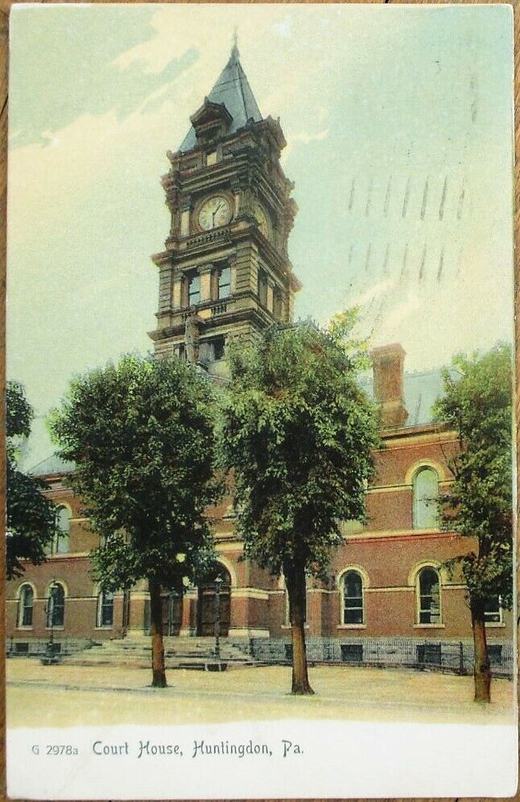
It is regularly laid out and contains about 120 dwellings, a court-house and a jail. A court of common pleas and general quarter sessions is held here the second Monday In January, April, August and November. It is 150 miles W.N.W. of Philadelphia." By the act of incorporation the first borough officers were named as follows : Joseph Cc^ill, chief burgess ; George McClellan, burgess ; Robert Patterson and Michael Foncannon, burgesses' assistants; James Robertson, town clerk ; Jeremiah Daily, high constable. It was further provided that these officers should serve until the first Monday in May, 1796, when the first borough election should be held. A supplementary act, approved by Governor Snyder on February 6, 181 1, provided for the election, "on the Friday next preceding the third Saturday of March next, and on the same day in every year hereafter," of a chief burgess, an assistant burgess, five reputable citizens to be a town council, and one reputable citizen to be a high constable.John W. Jordan, ed., History of the Juniata Valley and Its People (New York: Lewis Historical Publishing, 1913) · character 337,167 of the scanned text
Checked 2026-09-09 · County history, independently fact checked
← All stories from Huntingdon borough
Have something to add to this story, or a photograph of it? Send it here →
Photographs from Huntingdon borough
More from Huntingdon borough
Did you know? The man who ran the Museum of Fine Arts, Houston for 28 years found art in a freshman class at Juniata…
Huntingdon borough, HUNT Tower, the Switch Tower the Flood BuiltHUNT Tower stands just north of the tracks at the west end of the old station platforms in Huntingdon, where Fourth and…
Huntingdon borough, Native American Civil RightsDid you know? The man who helped bring the first national Native American rights organization into being spent the last…