Huntingdon borough
Juniata Canal 1832
Did you know? When Pennsylvania opened the Juniata canal, the boat that did it started from Huntingdon.
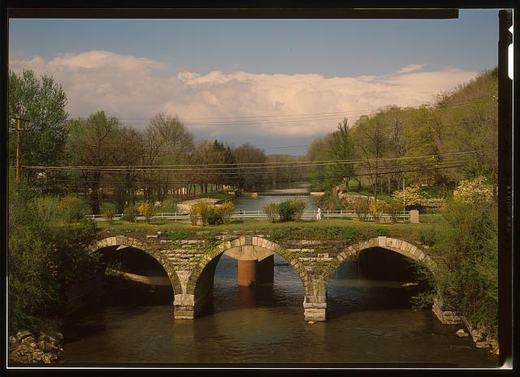
On November 27, 1832, the packet boat John Blair ran from Huntingdon up to Hollidaysburg, and that run officially opened the Juniata Division to traffic. The division climbed 584 feet across the 127 miles between Duncan's Island on the Susquehanna and Hollidaysburg.
The canal survey is candid about how it was built. Only four of the locks on this division were solid cut stone. Seven were rubble stone laid in mortar. The remaining seventy seven were wooden frames, planked watertight with boards four inches thick, held up by dry masonry and packed at the ends with mud and clay to keep the water in.
And it did not work right away. The record says that after the opening "it was subsequently discovered that some of the workmanship along that section was faulty and certain locks and several of the aqueducts had to be rebuilt before full operation was possible the following year."
So the famous first run out of Huntingdon was a ribbon cutting. The canal itself needed another year of repairs before it could really do the job.
Tell us the spot.
From the record
Passages about this subject, quoted from county histories now in the public domain. Each one names the book and the position in the text so it can be checked. Spelling is as printed.
It had a cabin at the bow for matter of personal comfort over the jolting stage- ! coach. The Frankstown line, the designation applied to the canal between Huntingdon and Hollidaysburg, was pushed with great energy, and in a little over a year was completed and placed in navigable order. On the 15th of November, at a meeting of the citizens of the county held at the Washington Hotel, in the borough of Huntingdon, for the purpose of adopting measures expressive of their gratification at the completion of the Juniata division of the canal, William Orbison presided, and Robert Williams acted as secretary. Resolutions were adopted declaring the importance of the public improvements, proposing a public celebration, and authorizing the appointment of a committee of arrangements to perfect a plan for the celebration and invite the State officials and others to participate. The committee consisted of John Henderson, M.D., Matthew McConnell, David R. Porter, James McCahan, William Dorris, Walter Clarke, and Robert Wallace, with the following as. sistant committees: Petersburg, Joseph Adams, William Walker; Alexandria, John Cresswell, John Porter; Williamsburg, Thomas Jackson, Adolphus Patterson; Frankstown, Henry B. Smith, Martin Denlinger; Hollidaysburg, Christian Garber, Samuel Smith, Christian Denlinger; Blairs Gap, John Walker.J. Simpson Africa, History of Huntingdon and Blair Counties, Pennsylvania (Philadelphia: Louis H. Everts, 1883) · character 249,360 of the scanned text
The effort in its favor was earnest and determined, and resulted in the passage of an act incorporating the " Huntingdon and Hollidaysburg Railroad Company," July 2nd, 1839. This road was probably always unnecessary, and was certainly so after the making of the Pennsylvania railroad. That a need for it is now growing up, and that it will probably take the place of the dismantled canal, is one of the revolutions of progress. The Pennsylvania Railroad Company was incorporated April 13th, 1816. Among the commissioners appointed by the act " to do and perform the several acts and things," therein mentioned, were John G. Miles, John Kerr, A. P. "Wilson, Edwin F. Shoenberger, Benjamin Leas, John McCahen, John Long, Brice Blair, Thomas E. Orbison and John Porter, of Huntingdon county. The first surveys through the county were made in the summer of 1817. By the 3rd of August, the engineers had progressed several miles west of Huntingdon in the direction of Petersburg. At that time they passed through the former borough on Washington street, but later in the same season they made a re-survey on Allegheny street, where the location of the road was determined upon. Proposals for the grading and masonry between Lewistown and Huntingdon were advertised for in April, 1818, and received until the 17th of May.Milton Scott Lytle, History of Huntingdon County (Lancaster: William H. Roy, 1876) · character 284,442 of the scanned text
J. C. Sechler was appointed ticket agent, and still remains at his post of duty, one of the oldest and most faithful employés of the road. The Juniata Division of the Pennsylvania Canal was finished to this place in 1830. The pioneer hardware store at this place was established by Lieut. Frank D. Stevens in 1867, on the corner of Shirley and Jefferson Streets, where he is still conducting one of the largest and most complete stores of the kind in this section of country. He was born in Springfield township, Huntingdon Co., Pa., March 18, 1841. On his father's side his ancestors came from Scotland, while his mother's people were from Germany. Benedict Stevens, the father of Lieut. Stevens, was born in Shirley township, same county, on the 28th of February, 1802. He grew to manhood on his father's farm in Shirley township, and eventually became 357 himself a farmer. He married, Oct. 8, 1822, Miss Eve Orr, and they became the parents of eight sons and seven daughters, of whom nine are now living. Five of the sons were in the Rebellion, serving from two to three years. Mrs. Stevens, after a long and well-spent life, passed away on the 31st of December, 1882, at the village of Three Springs, Clay township, where Benedict Stevens still resides. For more than half a century they have been members of the Metbodist Episcopal Church.J. Simpson Africa, History of Huntingdon and Blair Counties, Pennsylvania (Philadelphia: Louis H. Everts, 1883) · character 2,308,032 of the scanned text
Checked 2026-08-01 · County history, independently fact checked
← All stories from Huntingdon borough
Have something to add to this story, or a photograph of it? Send it here →
Photographs from Huntingdon borough
More from Huntingdon borough
Did you know? The man who ran the Museum of Fine Arts, Houston for 28 years found art in a freshman class at Juniata…
Huntingdon borough, HUNT Tower, the Switch Tower the Flood BuiltHUNT Tower stands just north of the tracks at the west end of the old station platforms in Huntingdon, where Fourth and…
Huntingdon borough, Native American Civil RightsDid you know? The man who helped bring the first national Native American rights organization into being spent the last…