Huntingdon borough
Why Huntingdon built the courthouse it has: a grand jury and the cheapest bid
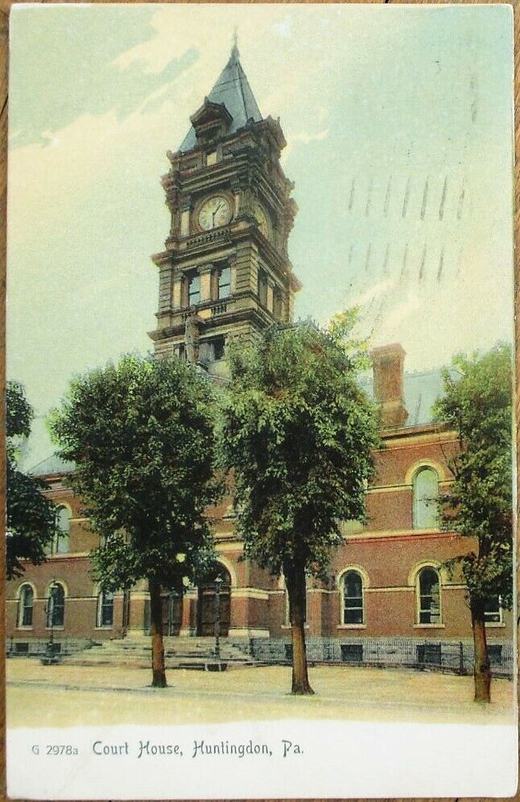
Did you know? The courthouse in Huntingdon exists because a grand jury said the old one was unfit, and the county then took the cheapest bid on the table.
A grand jury report laid out what was wrong with the old building, including that "witness-rooms, jury-rooms, and convenient out-buildings are deemed a public necessity." The grand jury endorsed the report at January sessions, 1882, and the court agreed.
Several plans came in. The commissioners picked one drawn by M. E. Beebe of Buffalo, New York. Six bids came in at the letting, running from $71,300 all the way up to $93,140.50, and the contract went to Henry Snare and Company at the low figure.
In June the county moved its offices into temporary quarters at the Morrison House, on the northeast corner of Third and Allegheny, and started tearing the old building down. By the twenty fourth of November the brickwork on the new courthouse had been carried almost to the top of the second story.
That building is still standing on that corner today.
What is the building in this county you would most hate to lose? Tell us which one.
From the record
Passages about this subject, quoted from county histories now in the public domain. Each one names the book and the position in the text so it can be checked. Spelling is as printed.
The contract was awarded to Henry Snare & Co. at the first mentioned sum. Temporary quarters f6r the public offices were provided in the Morrison House, northeast corner of Third and Allegheny Streets, in the month of June, and the work of removing the old building commenced and the present court house was completed in 1883. HE act erecting Huntingdon County authorized the commissioners to raise by taxation a sum o' money not exceeding £200 ($533.33), to be put into the hands of the trustees named in the law, for the purpose of building and finishing a court house and jail. This sum, together with about £200 more, chiefly subscribed by the inhabitants of the town, making an aggregate sum of $1066.66, was expended by the trustees in building a substantial house as a permanent jail, with provision for a temporary Court House over the same. It was erected on let No. 41, donated for the purpose by William Smith, D. D., located on the eastern side of Second Street, being the ground now occupied by the eastern extension of Penn Street. Before it was fully completed, it took fire and was destroyed. A prisoner, confined therein, was with some difficulty rescued from the flames.Historic Huntingdon, 1767-1909 · character 135,895 of the scanned text
He was also a brigadiergeneral of the militia. Gen. Smith married Miss Eliza Anthony, a very excellent lady. He resided in the stone house on the northeast corner of Third and Allegheny Streets, which has undergone many changes since, and has been for a long time known as the "Morrison House," in which the county offices are now temporarily located, awaiting the completion of the new court-house. Some years after the death of his first wife, Gen. Smith married Mary Van Dyke, a niece of Mrs. Richard Smith. After he left Huntingdon he lived in Bedford for a number of years. A gentleman who knew him during his long residence in Bedford speaks of him as a dignified, high-toned, and talented old gentleman, but somewhat eccentric. From Bedford he moved to- Mineral Point, Wis., where he performed much literary labor, and among other works wrote a history of Wisconsin in four volumes. The whole of this family of Smiths naturally inclined to literary pursuits. Richard Penn Smith, a brother of William R., became a popular dramatist and writer of fiction. Gen. Smith is said to have been a man of remarkably fine form and features. An old citizen says he was the handsomest man he ever saw, and another pronounced him the most accomplished man that ever lived in Huntingdon. He was cashier of the old Huntingdon Bank.J. Simpson Africa, History of Huntingdon and Blair Counties, Pennsylvania (Philadelphia: Louis H. Everts, 1883) · character 495,156 of the scanned text
Mr. Smith erected the stone building at the northeast corner of Third and Allegheny streets, now known as the " Morrison House," and lived in it during his residence in Huntingdon. There were other contributors of original articles to the Literary Museum, the most frequent of whom were J. X. Barker and Charles J. Cox. Their contributions were all poetical. The name of Moses Canan, Smith's co-editor, does not appear to any of the articles ; but he also was a man of literary HISTORY OF HUNTINGDON COUNTY. 121 talents, and may have written some of the prose which is published anonymously. The selections for the Museum were of a high order, and many periodicals of less merit have been more successful. We will not enter into a statement of the circumstances under which it existed, some of which were so favorable as to induce the undertaking, and others so contrary as to lead to its early abandonment. At the expiration of the first year, the editors closed their magazine with an address " to the public," giving their reasons for its discontinuance.Milton Scott Lytle, History of Huntingdon County (Lancaster: William H. Roy, 1876) · character 230,567 of the scanned text
Sources
- History of Huntingdon and Blair Counties, Pennsylvania, J. Simpson Africa / Louis H. Everts, Philadelphia (1883)
- National Register of Historic Places listings in Huntingdon County, Pennsylvania (checked to confirm the courthouse is NOT listed, therefore no nomination form exists to cite), Wikipedia (2026)
Checked 2026-08-01 · County history, independently fact checked
← All stories from Huntingdon borough
Have something to add to this story, or a photograph of it? Send it here →
Photographs from Huntingdon borough

More from Huntingdon borough
Did you know? The man who ran the Museum of Fine Arts, Houston for 28 years found art in a freshman class at Juniata…
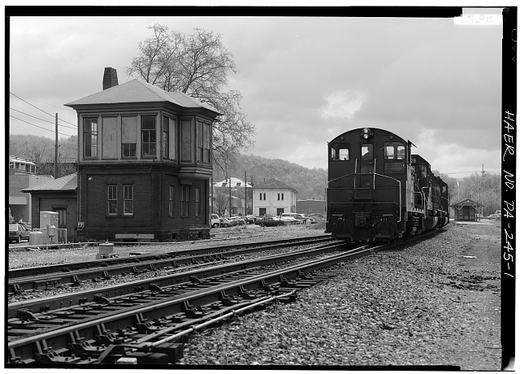
Huntingdon borough, HUNT Tower, the Switch Tower the Flood BuiltHUNT Tower stands just north of the tracks at the west end of the old station platforms in Huntingdon, where Fourth and…
Huntingdon borough, Native American Civil RightsDid you know? The man who helped bring the first national Native American rights organization into being spent the last…