Huntingdon County Information Page

Borough · Huntingdon County

Saltillo

5 stories on file, each with its sources. 0.2 square miles of land in the ridge and valley country of central Pennsylvania.

309
Population
2020 Census, P.L. 94-171
0.25 sq mi
Land area
2020 Census gazetteer
824 ft
Elevation
Community reference point, checked against USGS
Borough
Type
GEOID 4206167632

Nearby

Straight-line miles between map centers, 2020 Census boundary file

The founding record

Saltillo was laid out by Henry Hudson, and a borough charter was obtained from the court N ovember 10th, and recorded Dec. 1,1875. J. Simpson Africa, History of Huntingdon and Blair Counties, Pennsylvania (Philadelphia: Louis H. Everts, 1883) · character 1,626,814 of the scanned text
The following names comprised most, or all, of the members at Saltillo in 1879: Samuel McVitty and wife, John M. Wallace and wife, Emma McVitty, Amanda J. McVitty, George Senft and wife. The present membership is thirty-five. For list of preachers, see Three Springs Baptist Church. The Sunday-school connected with this branch reports an average attendance of sixty pupils, with Samuel McVitty, superintendent. Reformed Church of America., When the society at Saltillo was organized we are unable to state. The pioneer members of this church at this place were Philip Spahn, wife and two daughters, Anthony Hoffman, John Hoffman, Michael Brodbeck, Warner Thomas and wife, Mrs. Kimmell and daughter, Edward Cornelius and wife. In 1880 the society built a neat frame church located on Pine Street, Saltillo, at a cost of eight hundred dollars. Present membership, twenty-five. Their preachers have been Rev. John Shick, and , Writer, the present pastor. i The Sunday-school connected with -this church numbers twenty scholars, with William Abbott superintendent. Union Hall., This is a frame building, erected in 1873 by a joint-stock company, and located on Pine Street in the borough of Saltillo. It is occupied by all denominations who-wish to occupy it for religious purposes, and is used by the UJ. Simpson Africa, History of Huntingdon and Blair Counties, Pennsylvania (Philadelphia: Louis H. Everts, 1883) · character 1,630,342

Quoted from a work published before 1929 and therefore in the public domain in the United States. Spelling and punctuation are as printed, including nineteenth century spellings of place names. Scanned text carries optical character recognition errors; the character offset is given so the passage can be found and checked in the original.

5 stories

Stories from Saltillo

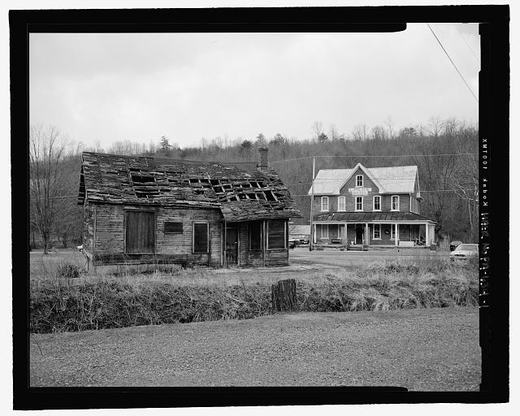
East Broad Top Railroad, Saltillo Station, Along the East Broad Top Railroad (at milepost 18.8) and PA Route 655, Saltillo
East Broad Top Railroad, Saltillo Station, Along the East Broad Top Railroad (at milepost 18.8) and PA Route 655, SaltilloLibrary of Congress, Historic American Buildings Survey / Historic American Engineering Record. No known copyright restrictions. pa4002

The Saltillo station stands between the East Broad Top main line at milepost 18.8 and South Main Street, Pennsylvania Route 655. The Historic American Engineering Record documented it as HAER PA-634, with seven photographs by A. Pierce Bounds in January 2004 and six measured drawings credited to John R. Bowie as delineator; the Friends of the East Broad Top sponsored the work and Henry F. Inman served as historian. One photograph shows the trackside elevation with the LaPalace Hotel behind it. The data pages are a single cover sheet, and the Library of Congress notes that unprocessed field note material exists for the structure.

The Library of Congress summary says the railroad established train service to Saltillo in 1874 and that the station building was constructed in 1892. The county's 1991 inventory of historic engineering and industrial sites also places an EBT station here around 1892. The two records disagree about what came next: the summary describes the 1892 building as altered and enlarged, with a concrete foundation, a bay window and a raised roof peak, while the inventory describes a one story wood frame replacement station, modified again later. The inventory says the station closed when the EBT suspended operation south of Orbisonia in 1956; the National Register nomination for the railroad puts the company's last train on April 16, 1956.

The inventory says Saltillo was the site of a tannery and the departure point for short spurs to iron ore, limestone and ganister rock deposits nearby. Jordan's 1913 history of the Juniata Valley says the ground was settled in 1796 by Henry Hubbell, who built a grist mill in 1797; that Thomas Greer filed the plat of a town called Springville on August 20, 1796; and that Henry Hudson later laid out Saltillo, incorporated as a borough on December 1, 1875, with Samuel McVitty as its first chief burgess.

Checked against the record. Checked against the survey's written record before publication; 4 claims it did not support were removed or corrected.

Open this story on its own page →

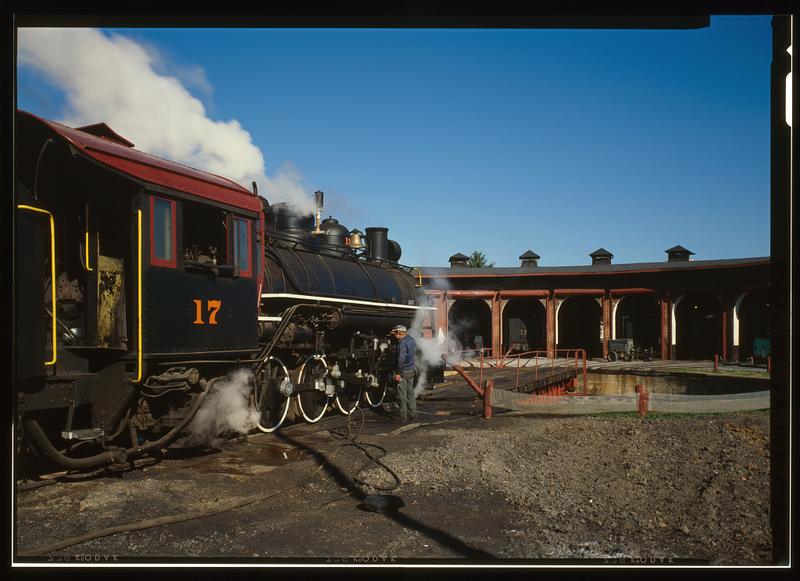
East Broad Top Railroad & Coal Company, Roundhouse, State Route 994, West of U.S. Route 522, Rockhill Furnace
East Broad Top Railroad & Coal Company, Roundhouse, State Route 994, West of U.S. Route 522, Rockhill FurnaceLibrary of Congress, Historic American Buildings Survey / Historic American Engineering Record. No known copyright restrictions. pa3371

The East Broad Top Railroad's shops stand on Meadow Street in Rockhill Furnace, a middle point on a three-foot-gauge line that ran from Mount Union to Alvan. The nomination calls the railroad one of the oldest narrow gauge lines in America, and a 1991 National Park Service inventory of the county's industrial sites records that it was designated a National Historic Landmark in 1964.

The nomination says the East Broad Top Railroad and Coal Company was established in 1871, after the Civil War interfered with an earlier plan to reach the Broad Top coal. Africa's 1883 county history says the company had been organized under an act approved April 16, 1856, that construction began on September 16, 1872, and that the road opened to Robertsdale, its southern terminus, on November 4, 1874. The 1991 inventory says the owners of Rockhill Furnace built the line to reach iron ore and coal in the region, and that it reached its greatest length in 1916 with the extension to Alvan. The road carried timber, sand, rock, general freight and passengers, but coal was its great money-maker: trains hauled it to Mount Union, where it was transferred to the Pennsylvania Railroad. In 1881, Africa records, the road carried 143,449 tons of bituminous coal.

After World War II other fuels began to supplant coal. Passenger service ended in 1953, and on April 16, 1956, the company ran its last train. The purchaser of the entire line preserved five miles of track and six steam locomotives, Mikado types built for the East Broad Top by the Baldwin works of Philadelphia, and began running part of the line as a tourist attraction in 1960. The 1991 inventory names the buyer as the Kovalchick Salvage Company of Indiana, Pennsylvania, and says the town of Orbisonia asked for the reopening to commemorate its bicentennial.

The bulk of the Rockhill yard dates from 1874, including the red brick roundhouse with berths for eight engines and the Armstrong turntable. When the form was written in 1974 the blacksmith shop, foundry and machine and car shops still housed their original machinery, and the foundry was filled with patterns used in making the rolling stock. About 1,400 feet of grade north of Shirleysburg washed out in 1972. Across Meadow Street, the Orbisonia passenger station had its waiting room converted into a gift shop and its freight room into a snack bar.

Decline in the use of coal after World War II forced the East Broad Top to cease operations in 1956. All of its track and rolling stock seemed doomed, but the purchaser of the line generously preserved five miles of the track and six of the steam engines.National Register of Historic Places nomination, East Broad Top Railroad (reference 66000666), 66000666, p. 3 · character 7,078 of the scanned text
Checked against the record. Checked against the National Register nomination text before publication; 3 claims the nomination did not support were removed or corrected.

Open this story on its own page →

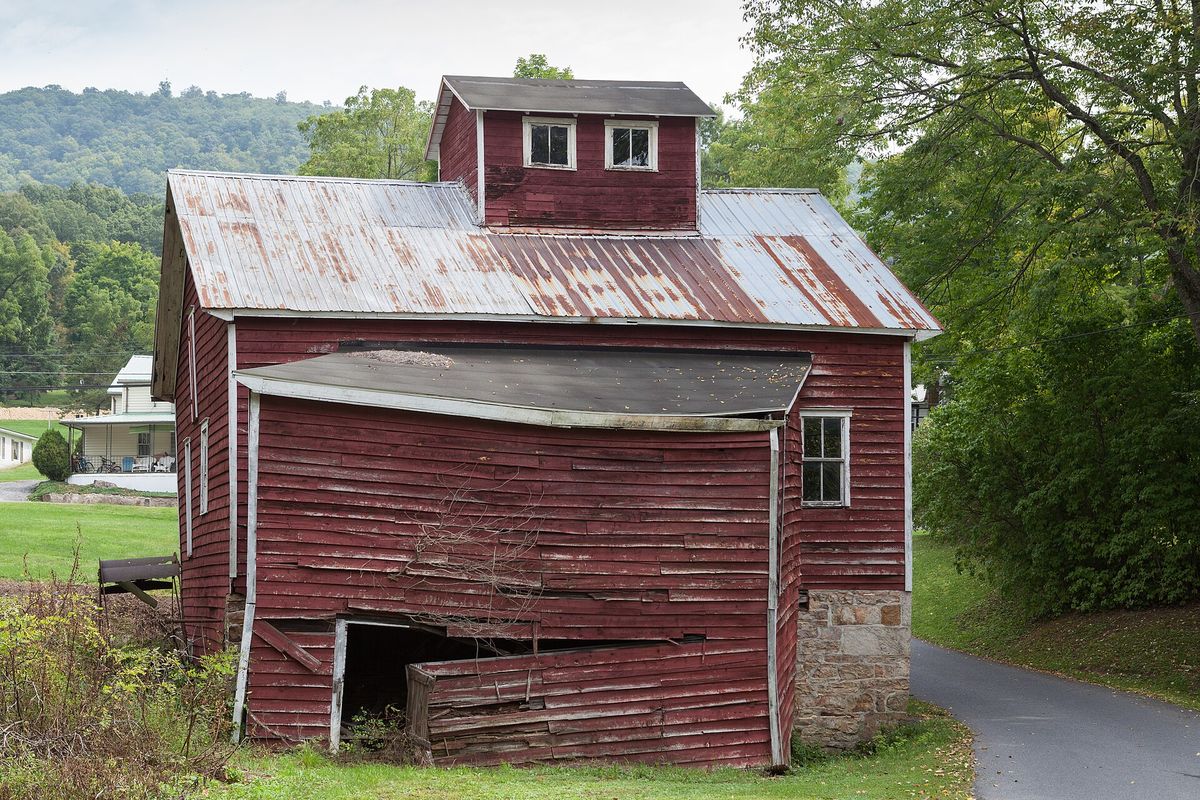
The Hudson Grist Mill on the main street of Saltillo, west side, with the shed addition.
The Hudson Grist Mill on the main street of Saltillo, west side, with the shed addition.Generic1139 stg04

On Route 829, the main street of Saltillo, stands a two and a half story frame grist mill measuring 36 by 28 feet, clapboard sided, on a coursed rubble stone foundation under a metal roof. The National Register nomination calls it the Hudson Grist Mill and gives Crotsley Mill as its other name.

The site is older than the building. Henry Hubbell, the pioneer owner of the land the town sits on, built grist and saw mills on North Spring Creek in 1797. A log dam a quarter mile upstream fed a 14 foot overshot bucket wheel that ran both. Africa's 1883 county history adds that Hubbell had arrived in 1796 and, with an adjoining landowner named Thomas Greer, laid out the town as Springville, with a lot on the plat set apart for a courthouse. In 1850 the grist mill was rebuilt and its value rose from $400 to $1,000. Who rebuilt it is told two ways: the nomination says Hubbell's heirs, Africa says the Hudson heirs. How much of the 1797 structure, if any, survived the rebuilding, the nomination says, is unknown.

George Hudson owned the mill from 1850 to 1859, then Henry Hudson until 1864, when he sold to A. K. Green before going off to serve in the Civil War. Philip E. Weaver and his son Henry T. ran it from 1880 to 1920, replacing the buhr stones with modern milling equipment in 1905. In 1920 Edgar G. Weaver and Charles Crotsley fitted a 16 horsepower Fitz overshot steel water wheel, backed by a 20 horsepower Fairbanks Morse kerosene engine for low water, built the grain bin addition over the tail race and reinforced the log dam with concrete. Crotsley became sole owner in 1924 and kept the business going until 1940.

The nomination, prepared in November 1989 under the Industrial Resources of Huntingdon County multiple property listing, cites Criterion A: an example of an important county industry and of the continuing use of an early milling site, with the unusual feature of a twentieth century water wheel. The 14 foot Fitz wheel, made in Hanover, Pennsylvania according to the National Park Service's 1991 inventory of the county's industrial sites, remains in badly deteriorated condition. Much of the milling equipment went in the early 1950s, when Kenneth Crotsley cleared it out for a pre-bagged feed business that ran only briefly. A cockle machine and a few minor pieces stayed behind.

In 1920, Edgar G. Weaver and Charles Crotsley updated the operation by installing a 16-horsepower Fitz overshot steel water wheel, with a 20-horsepower Fairbanks Morse kerosene engine for auxiliary power when water was low.National Register of Historic Places nomination, Hudson Grist Mill (reference 90000390), 90000390, section 8, p5 · character 5,558 of the scanned text
Checked against the record. Checked against the National Register nomination text before publication; 4 claims the nomination did not support were removed or corrected.

Sources

  1. National Register of Historic Places nomination: Hudson Grist Mill, reference 90000390 (1989)
  2. J. Simpson Africa, History of Huntingdon and Blair Counties, Pennsylvania (Saltillo Borough chapter, p. 250) (1883)
  3. Huntingdon County, Pennsylvania: An Inventory of Historic Engineering and Industrial Sites (Hudson Grist Mill entry, p. 149) (1991)

Open this story on its own page →

From the newspaper the county was reading at the time, on Saltillo borough. A correspondent of the Huntingdon Journal wrote up a visit to the town, and the paper printed it on 10 December 1875. The passage below is printed exactly as it appears, including the spelling of the day and the errors the scanner made. It has not been rewritten, summarised or added to.

Saltillo is improving considerably, several new houses have gone up since my June visit, and the improved appearances are very striking. McVitty the life and master-wheel of this place and community still lives, consequently the town must live. His Tannery is working off 125 hides per week which gives us some idea of McVitty's real worth to the community. All the bark he uses, which is many thousand cords a year, is produced within the immediate vicinity of Saltillo, or at least the larger part of it. Saltillo has a nice hotel also. The Broadbeck House has changed hands, it is now kept by Mr. Elias E. Borst, under the name of the "Royer House." It is strictly a Temperance House, consequently a nice, civil home-like accommodation for Local and Trancient custom who enjoy good eating, good treatment, and quiet rest at night.Huntingdon Journal, 10 December 1875, p. 3 · character 0 of the scanned text

Open this story on its own page →

Hudson Grist Mill, the west side and shed addition, and the remains of a Fitz steel water wheel
Hudson Grist Mill, the west side and shed addition, and the remains of a Fitz steel water wheelGeneric1139, via Wikimedia Commons. Creative Commons Attribution-ShareAlike 3.0. NRHP 90000390

Saltillo's first photograph on this site is of a mill on the National Register of Historic Places. The picture shows the west side, the shed addition, and what is left of a Fitz steel water wheel. The Fitz Water Wheel Company of Hanover, Pennsylvania built overshot steel wheels for mills like this one into the twentieth century, long after most of the country had gone to turbines.

Open this story on its own page →

Where it sits

Alexandria borough: 12 storiesBirmingham borough: 2 storiesBroad Top City borough: 2 storiesCassville borough: 2 storiesCoalmont borough: 2 storiesDudley borough: 2 storiesHuntingdon borough: 36 storiesMapleton borough: 6 storiesMarklesburg borough: 4 storiesMill Creek borough: 4 storiesMount Union borough: 137 storiesOrbisonia borough: 8 storiesPetersburg borough: 3 storiesRockhill borough: 5 storiesSaltillo borough: 5 storiesShade Gap borough: 3 storiesShirleysburg borough: 4 storiesThree Springs borough: 4 storiesBarree township: 6 storiesBrady township: 4 storiesCarbon township: 3 storiesCass township: 2 storiesClay township: 4 storiesCromwell township: 7 storiesDublin township: 5 storiesFranklin township: 10 storiesHenderson township: 6 storiesHopewell township: 5 storiesJackson township: 9 storiesJuniata township: 8 storiesLincoln township: 5 storiesLogan township: 5 storiesMiller township: 4 storiesMorris township: 2 storiesOneida township: 6 storiesPenn township: 4 storiesPorter township: 10 storiesShirley township: 10 storiesSmithfield township: 5 storiesSpringfield township: 5 storiesSpruce Creek township: 7 storiesTell township: 3 storiesTodd township: 5 storiesUnion township: 5 storiesWalker township: 9 storiesWarriors Mark township: 5 storiesWest township: 2 storiesWood township: 13 storiesHuntingdonMount UnionOrbisoniaThree SpringsPetersburgMapletonAlexandriaRockhillBroad Top CitySaltillo
10 or more4 to 91 to 3borough outline