Huntingdon County Information Page

Township · Huntingdon County

Franklin

10 stories on file, each with its sources. 31.5 square miles of land in the ridge and valley country of central Pennsylvania.

495
Population
2020 Census, P.L. 94-171
31.47 sq mi
Land area
2020 Census gazetteer
0.01 sq mi
Water
2020 Census gazetteer
Township
Type
GEOID 4206127416

Nearby

Straight-line miles between map centers, 2020 Census boundary file

The founding record

Franklin township was erected in March, 1789, from the old town-, ship of Tyrone, and was the first new township to be established after the organization of Huntingdon county. It extends from the Center county line on the northeast to the Little Juniata river on the southwest, and from Warriors Mark township on the northwest to the summit of Tussey's mountain on the southeast. Among the early settlers were Alexander Ewing, Zephaniah Weakland, George Mattem, Jacob Miner, Abraham Sells, Richard Ricketts, James Hunter, James Armitage and the Hendersons. The township has rich deposits of iron ore, which were first worked about 1795 or 1796, when the Huntingdon furnace was built in the midst of the ore beds and the Pennsylvania furnace in the northern part of the township, near the Center county line. Spruce creek rises in this township and flows almost the entire length of it, emptying into the Little Juniata. The water power of this stream was utilized as early as 1785 to run what was long known as the old Bebault mill. Many years later W. D. & J. D. Isett established the Stockdale Woolen Mills at the mouth of the stream and about a mile farther up J. Q. Adams started an ax factory. Franklinville and Graysville are the principal villages. John W. Jordan, ed., History of the Juniata Valley and Its People (New York: Lewis Historical Publishing, 1913) · character 185,735 of the scanned text

Quoted from a work published before 1929 and therefore in the public domain in the United States. Spelling and punctuation are as printed, including nineteenth century spellings of place names. Scanned text carries optical character recognition errors; the character offset is given so the passage can be found and checked in the original.

10 stories

Stories from Franklin

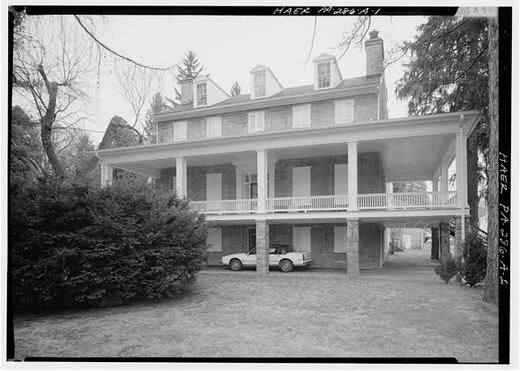
Pennsylvania Furnace, Ironmaster's Mansion, West of State Route 45, South of Centre County line, Pennsylvania Furnace
Pennsylvania Furnace, Ironmaster's Mansion, West of State Route 45, South of Centre County line, Pennsylvania FurnaceLibrary of Congress, Historic American Buildings Survey / Historic American Engineering Record. No known copyright restrictions. pa2907

The Historic American Engineering Record's photographs of the ironmaster's mansion at Pennsylvania Furnace carry survey number HAER PA-286-A and a cover sheet with no history of its own. The written record sits in the parent survey of the furnace, HAER PA-286, edited by Gray Fitzsimons and Kenneth Rose as part of the documentation project begun in 1987 that produced the county inventory.

That survey says a partnership of John Lyon, Jacob Haldeman and William Wallace established the furnace in 1813 on the Huntingdon and Centre county line, with water power from Spruce Creek. By 1820 it employed seventy men and made 1,000 tons of pig iron a year. Lyon kept his strongest interest here and in 1834 built the twenty-eight-room mansion, which three generations of his family lived in.

The surveyors describe an L-shaped house of native limestone, roughly 70 by 50 feet, rising from two and a half stories on the east end to four full stories on the west. The five-bay front is strictly symmetrical, with a paneled door framed by a transom and sidelights and three gable-roofed dormers; the east gable keeps its symmetry with six false windows that read as closed shutters. The front porch on stone piers dates from about 1920. The survey calls the house the largest of the county's ironmaster's houses and one of the best preserved, with cast-iron fireplace inserts and hand-made hardware still in place, and points readers to student drawings of the house, HABS PA-611, which its source list dates to 1962. It also records a county line argument: an 1826 Bellefonte writer claimed the stack and nearly all the buildings lay in Centre County, while tax rolls and the census consistently placed the works in Huntingdon County.

J. Simpson Africa's 1883 history adds the family. It says John Lyon married a sister of David Stewart, the Dauphin County man who came to Pennsylvania Furnace as manager and became a part owner, and that their son George W. Lyon was the resident partner of the furnace company, living in the mansion when the book was written. The survey says steam machinery was added in 1856 and the furnace stopped in 1888.

Checked against the record. Checked against the survey's written record before publication; 7 claims it did not support were removed or corrected.

Open this story on its own page →

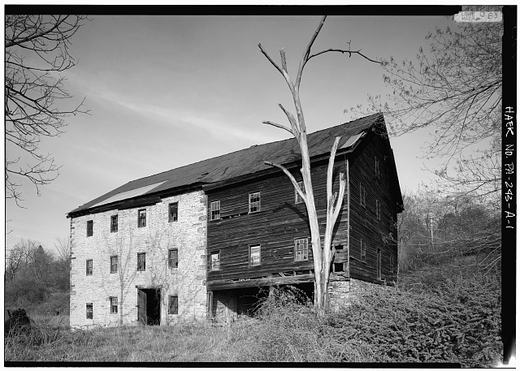
Huntingdon Furnace, Grist Mill, 2 miles northwest of Colerain Mansion, Franklinville
Huntingdon Furnace, Grist Mill, 2 miles northwest of Colerain Mansion, FranklinvilleLibrary of Congress, Historic American Buildings Survey / Historic American Engineering Record. No known copyright restrictions. pa2730

The Historic American Engineering Record photographed the grist mill at Huntingdon Furnace under survey number HAER PA-243-A, a cover sheet with no written history of its own. The mill's record lives in the parent survey of the furnace, HAER PA-243, compiled by historians Nancy Shedd and Ken Heineman as part of a documentation project the survey says began in February 1987, with its results published in the 1991 county inventory.

That survey describes a three-and-a-half-story rubble stone building, 50 by 45 feet, built about 1808 and later joined by a 45 by 35 foot post-and-beam addition with weathered clapboard siding. Inside, the surveyors found chamfered posts and girders, beading on the joists, some milling machinery, and a small AC generator made by the Crocker-Wheeler Company. Outside they found an all-iron overshot water wheel fed by an iron pipe running from the creek, and a north wall partly collapsed where the wheel shaft passes through it.

The survey says the mill was built to supply flour for the ironworkers' families and feed for the furnace horses, mules and cows, and that it kept serving local farmers until about 1920. After the grinding stopped, its turbines were replaced with the metal wheel that survives, and that wheel was later connected to the generator, which the Lake and Hindman families used to furnish their property with electricity. The survey also reports that the mill is said to have held the first Sunday school and church meetings of the ironworks community.

J. Simpson Africa's 1883 county history adds an earlier chapter. It says the company in due time built a good mill near the new furnace, still in operation when the book was written, and that the first Sunday school in that part of the valley opened in the old stone mill at Huntingdon Furnace about 1821, started by Samuel Mattern, Samuel Conrad, Ephraim Galbraith and Jeremiah Cunningham. The 1991 county inventory reproduces two of Jet Lowe's photographs of the mill, one of the building and one of its drive train.

Checked against the record. Checked against the survey's written record before publication; 4 claims it did not support were removed or corrected.

Open this story on its own page →

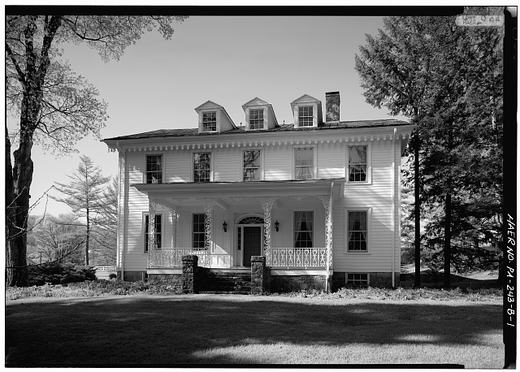
Huntingdon Furnace, Ironmaster's Mansion, 2 miles northwest of Colerain Mansion, Franklinville
Huntingdon Furnace, Ironmaster's Mansion, 2 miles northwest of Colerain Mansion, FranklinvilleLibrary of Congress, Historic American Buildings Survey / Historic American Engineering Record. No known copyright restrictions. pa2731

The ironmaster's mansion at Huntingdon Furnace, two miles from Colerain Mansion in the Franklinville vicinity, was photographed by the Historic American Engineering Record as HAER PA-243-B. The written history is in the parent report on the furnace, PA-243, compiled by historians Nancy Shedd and Ken Heineman, which calls Huntingdon Furnace the most extensive and best-preserved iron furnace site in the county.

The survey dates the mansion to 1851 and describes a two-story, L-shaped frame house whose front block is 50 feet wide, with five bays and three gable-roofed dormers. Its three-bay porch has a paneled ceiling and wall above wainscoting and decoratively patterned cast iron. A standing-seam metal roof overhangs intricately patterned trim that runs around the whole house, and the six-over-six windows are joined by paired round-topped attic windows in the gable ends.

The furnace the mansion served was older by half a century. The survey says George Anshutz, an experienced ironmaker from Alsace, in France, had built the first furnace in the Pittsburgh area in 1792, which failed in part for being too far from its ore, and by 1796 had joined other investors in a furnace on Warriors Mark Run; by 1805 that first stack was abandoned and the present furnace built. J. Simpson Africa's 1883 county history tells the same story and names the partners: Mordecai Massey owned the land, Judge John Gloninger of Lebanon put in the money, and Anshutz brought the skill. In the 1830s, the survey says, the holdings passed to Peter Shoenberger, whom it calls the Iron King, and at his death in 1854 to his sons George and John. Africa says the furnace ran on charcoal until scarcity of wood led to its abandonment in 1870; the survey has it out of blast by the 1880s.

The furnace farms kept going. When the survey visited, the owner, Edward Newlin, was the latest in a long line of farmers on the property, and the grist mill of about 1808 nearby still had its overshot water wheel, of all-iron construction, fed by an iron pipe from the creek.

Checked and confirmed. Every date, name and number was matched to the survey's written record before publication.

Open this story on its own page →

Pennsylvania Furnace, West of State Route 45, South of Centre County line, Pennsylvania Furnace
Pennsylvania Furnace, West of State Route 45, South of Centre County line, Pennsylvania FurnaceLibrary of Congress, Historic American Buildings Survey / Historic American Engineering Record. No known copyright restrictions. pa2906

A tenth of a mile west of Route 45, just south of the Centre County line, stands an L-shaped house of native limestone about 50 by 70 feet, two and a half stories at its southeast end and a full four at the northwest. The five bay front is strictly symmetrical, with a paneled door framed by a transom and sidelights, and the symmetry of the southeast gable end is kept up with six false windows that read as closed shutters. John Lyon built it in 1834, and the National Register nomination says three generations of his family lived in its twenty-eight rooms.

The furnace it served began in 1813, when John Lyon, Jacob Haldeman and William Wallace set up a well capitalized iron furnace on the Huntingdon-Centre line, powered by Spruce Creek and named Pennsylvania Furnace. Africa's 1883 county history names the same three men and the same year. By 1820 it employed seventy men and made 1000 tons of pig iron a year, with Robert T. Stewart an owner alongside Lyon. Output rose to 1500 tons by the 1820s and to almost 2000 tons in later years. Pig iron made here went to the Sligo, Colerain or Tyrone forges for working into blooms, then to the Sligo Works at Pittsburgh for rolling. Steam machinery was added in 1856. It stopped in 1888.

Of the mines, timber lands, farms, schools, mills and housing that once made up the plantation, the survey behind the nomination found only the mansion and one outbuilding, a four door clapboard privy, with enough integrity to count. The house keeps its cast iron fireplace inserts and handmade hardware; the front porch dates from about 1920. The nomination calls it the largest and most architecturally detailed ironmaster's mansion in the county and lists it under Criteria A and C, industry and architecture, with a period of significance from 1834 to 1888.

Which county the furnace belonged to was argued over. The nomination quotes an 1826 Bellefonte writer who put the stack, nearly all the buildings, the ore bank and the coaling ground in Centre County, while the operation was taxed and counted by the census in Huntingdon County. The mansion, the nomination says, is clearly on the Huntingdon side. An early photograph of the furnace shows a signpost, perhaps marking the line, standing immediately in front of the stack.

The Pennsylvania Furnace or Lyon mansion is the largest of Huntingdon County's ironmaster's houses and one of the best preserved, retaining much of its Federal period detail, including cast iron fireplace inserts, hand-made hardware, and a transom and sidelights around the central door.National Register of Historic Places nomination, Pennsylvania Furnace Mansion (reference 90000409), Pennsylvania Furnace Mansion, section 8, p6 · character 7,088 of the scanned text
Checked and confirmed. Every date, name and number was matched to the National Register nomination text before publication.

Open this story on its own page →

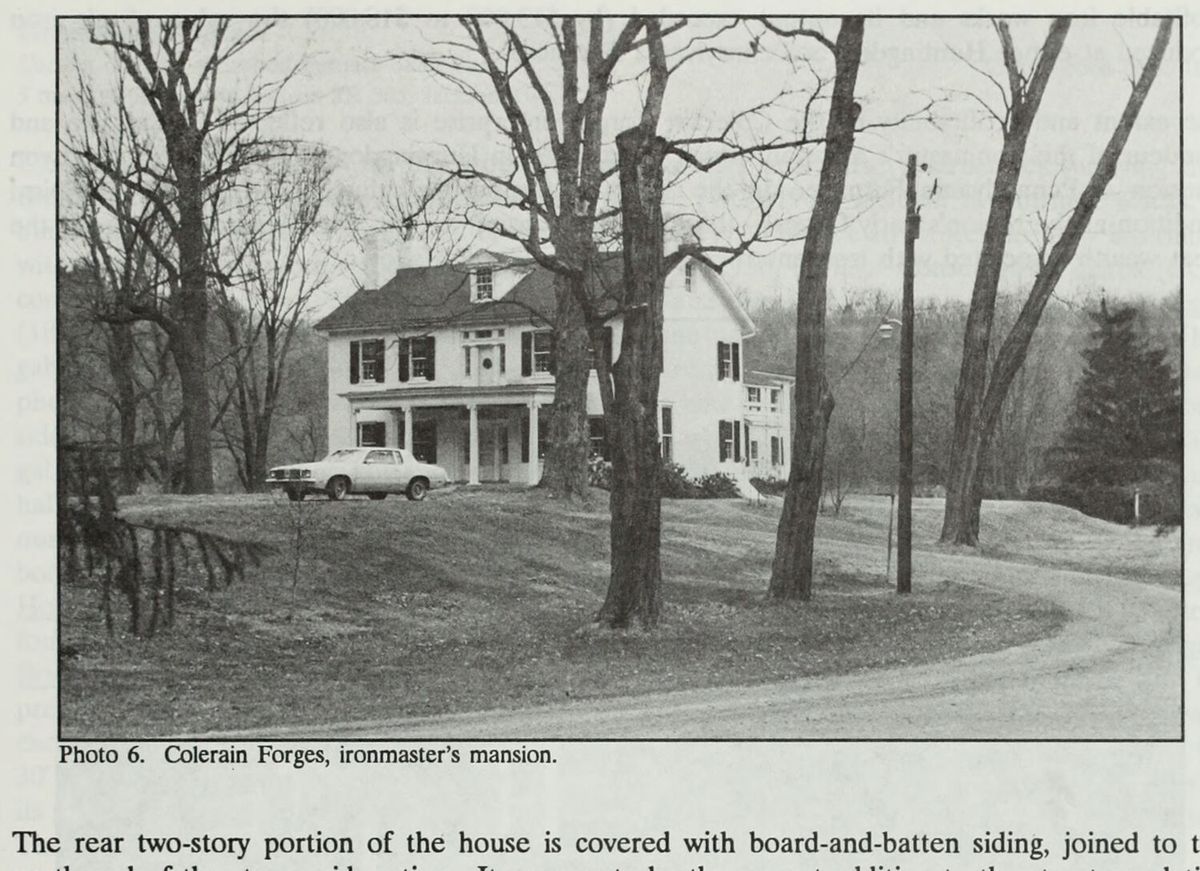
The ironmaster’s mansion at Colerain Forges, photographed for the National Park Service survey of the county’s industrial sites.
The ironmaster’s mansion at Colerain Forges, photographed for the National Park Service survey of the county’s industrial sites.Nancy S. Shedd et al., Huntingdon County, Pennsylvania: An Inventory of Historic Engineering and Industrial Sites (Historic American Buildings Survey / Historic American Engineering Record, National Park Service, 1991), photograph 6 shd006

On the west side of Route 45, three quarters of a mile south of Franklinville, a white T-shaped house stands in a grove of old trees on a bend of Spruce Creek. It was the ironmaster's mansion of Colerain Forges, and the nomination calls it the only surviving resource of the forge operation that once stood across the road.

The nomination says three forges were built near Spruce Creek in the 1810s: Upper and Lower Sligo, in 1810 and 1814, by Patton and Roach, and Marshall's, by Samuel Marshall. Africa's 1883 county history puts Marshall's start earlier; the two sources disagree on the year. Between 1819 and 1826 John Lyon and Robert T. Stewart, owners of Pennsylvania Furnace, consolidated them under the name Colerain Forges. In 1831 the partners acquired Huntingdon Furnace, and the nomination says Colerain Forge was built to process the iron that furnace produced. David Stewart managed the forges and lived in the mansion; Africa says he moved to Coleraine Forges in 1831 and died there in May 1869, aged seventy-seven. Thomas S. Lyon ran the operation after him until the last forge closed in 1874.

Africa puts the output of blooms from February 28, 1828, to February 28, 1860, at 29,661 tons. The nomination says the manufacturers' censuses of 1850 and 1860 valued a year's production at more than $60,000, $13,000 to $18,000 above the pig iron made at Huntingdon Furnace or Pennsylvania Furnace individually.

The house was built in four sections of three materials. The nomination says the plastered stone middle section is the oldest and probably dates from the late 1700s; the frame east portion of the front dates to the 1830s, the brick west portion to the 1840s, and a board-and-batten rear section probably to the 1860s or 1870s. A stone outbuilding east of the house, 18 by 28 feet, is counted as contributing. In 1968 architecture students from Carnegie-Mellon University drew the house to Historic American Buildings Survey standards.

The nomination, prepared in July 1989 and received by the National Park Service in February 1990, put the mansion forward under the Industrial Resources of Huntingdon County listing for its association with the local iron industry and as an example of Federal architecture, with a period of significance of 1810 to 1874. When Africa wrote in 1883, two of David Stewart's daughters, Catherine W. and Margaret, still occupied the homestead at Coleraine.

Checked against the record. Checked against the National Register nomination text before publication; 3 claims the nomination did not support were removed or corrected.

Open this story on its own page →

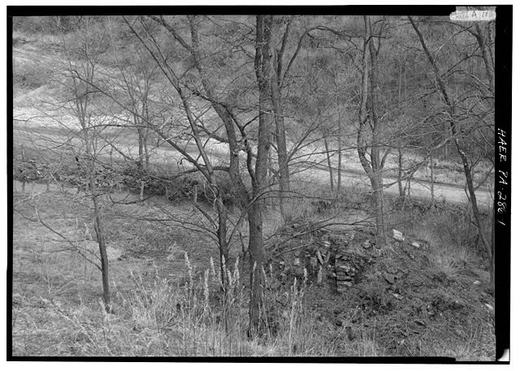
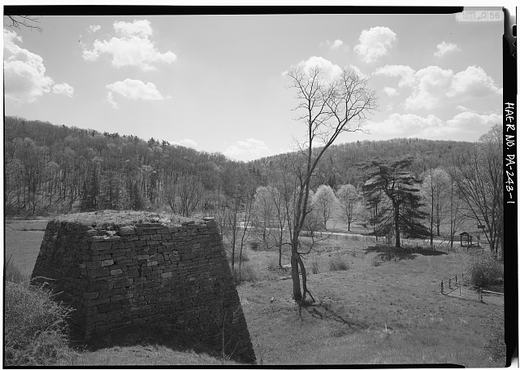
Huntingdon Furnace, 2 miles northwest of Colerain Mansion, Franklinville
Huntingdon Furnace, 2 miles northwest of Colerain Mansion, FranklinvilleLibrary of Congress, Historic American Buildings Survey / Historic American Engineering Record. No known copyright restrictions. pa2729

Two miles northwest of the Colerain Mansion in Franklin Township, a stone blast furnace stack stands at the bottom of a steep incline at the edge of a cow field. It measures 30 by 30 by 30 feet, built of rubble limestone and sandstone with round arched openings on the east and north faces. The National Register nomination of 1989 describes it as in excellent, original condition, still holding its tie rods with washers and wedges and refractory materials from an early date.

The nomination says the furnace was developed by George Anshutz, an ironmaker from Alsace who built Pittsburgh's first iron furnace on Two-mile Run in 1792. By 1796 Anshutz had joined John Gloninger and Mordecai Massey in a furnace on Warriors Mark Run upstream of the present site. Africa's 1883 county history adds a fourth partner, Martin Dubbs of Philadelphia, and describes the start: fifteen acres bought in 1796, a small furnace, one horse and a yoke of cattle for a working outfit. By 1805 the old seat had been abandoned and the present furnace built downstream. Trading as John Gloninger and Co., the operation reinvested its profits in timber, ore mines and farmland, and built the stone grist mill about 1808. By 1819 the holdings reached 40,000 acres, and the 1820 census of manufactures counted 206 men in the combined Gloninger enterprises.

In the 1830s the property passed to Peter Shoenberger, the "Iron King," and at his death in 1854 to his sons George and John. Africa reported the furnace out of blast in 1883 and the farms in a high state of cultivation. The stone mill outlived the furnace, grinding for area farmers until about 1920. Africa records the first Sunday school in that part of the valley opening in the old stone mill about 1821.

The district was listed under Criteria A and C, industry and architecture, as a good example of an iron plantation; the nomination calls it the most extensive and best preserved iron furnace site in the county. Eight contributing resources survive: the stack, the office, the 1851 ironmaster's mansion, a log workers' house the nomination describes as the county's only known example of half dovetailed log construction, a frame farm worker's house, the farm manager's house, the grist mill and the miller's house. Africa put the furnace's output, when last in blast, at forty-five tons of iron a week.

It began as a small operation, merely 15 acres in 1796. By 1805, the "old seat" had been abandoned and the present furnace built a mile downstream.National Register of Historic Places nomination, Huntingdon Furnace (reference 90000407), 90000407, section 8, p7 · character 11,714 of the scanned text
Checked and confirmed. Every date, name and number was matched to the National Register nomination text before publication.

Sources

  1. National Register of Historic Places nomination: Huntingdon Furnace, reference 90000407 (1989)
  2. J. Simpson Africa, History of Huntingdon and Blair Counties, Pennsylvania (Franklin Township chapter, Huntingdon Furnace and Sunday school passages) (1883)

Open this story on its own page →

Did you know? By 1819 the Huntingdon Furnace estate had spread over an area of more than forty thousand acres.

Many stoves were cast there, and in 1883 the county history said the name Huntingdon Furnace could still be seen on stoves in places where wood was still burned. Out of the needs and profits of the furnace grew a forge on Spruce Creek built about 1800, the upper and lower Tyrone Forges, a rolling mill, a slitting mill, nail factories, a saw and grist mill, and Bald Eagle Furnace.

Not far away, Juniata Forge, on the Juniata below Petersburg, was built about 1804 by Samuel Fahnestock and George Shoenberger, and it was still running in 1882.

Checked and confirmed. CONFIRMED 2026-10-03 against the sources listed: every factual sentence was tied to a verbatim passage and a script confirmed each passage is in its source. Where sources disagreed on a number, the number was left out.

Open this story on its own page →

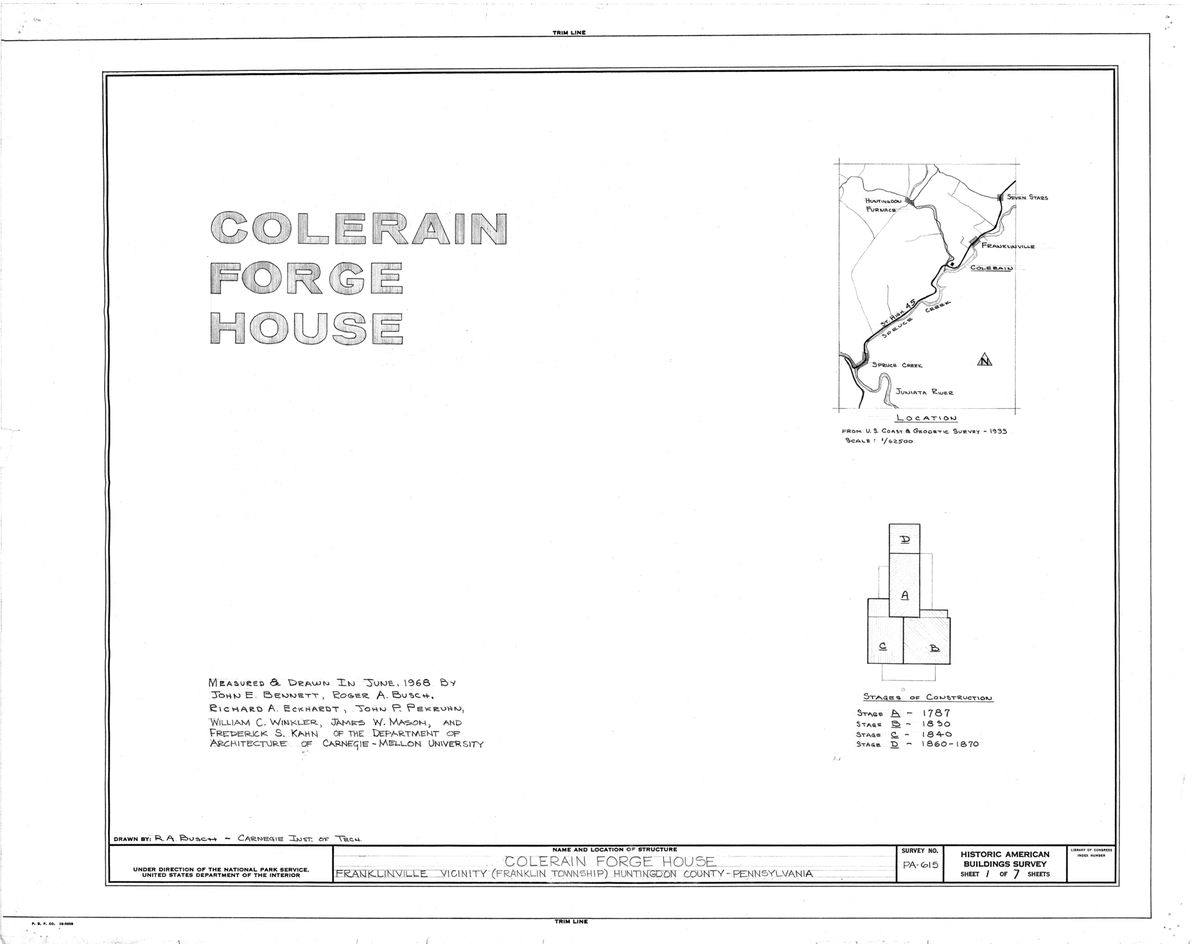
Colerain Forge House
Colerain Forge HouseHistoric American Buildings Survey, Library of Congress. A work of the United States Government; no known copyright restrictions. Via Wikimedia Commons. Colerain Forge House, State Route 45 vicinity (Franklin Township), Franklinville, Huntingdon County, PA HABS PA,31-FRNK.V,1- (sheet 1 of 7).png

The Colerain Forge House stands off State Route 45 in Franklin township, and was recorded by the Historic American Buildings Survey. Federal survey photography carries no copyright, which is why so much of the oldest building record on this site comes from it.

Checked against the record. Placed by the photograph's own coordinates against the Census geocoder, which returns Huntingdon / Franklin.

Open this story on its own page →

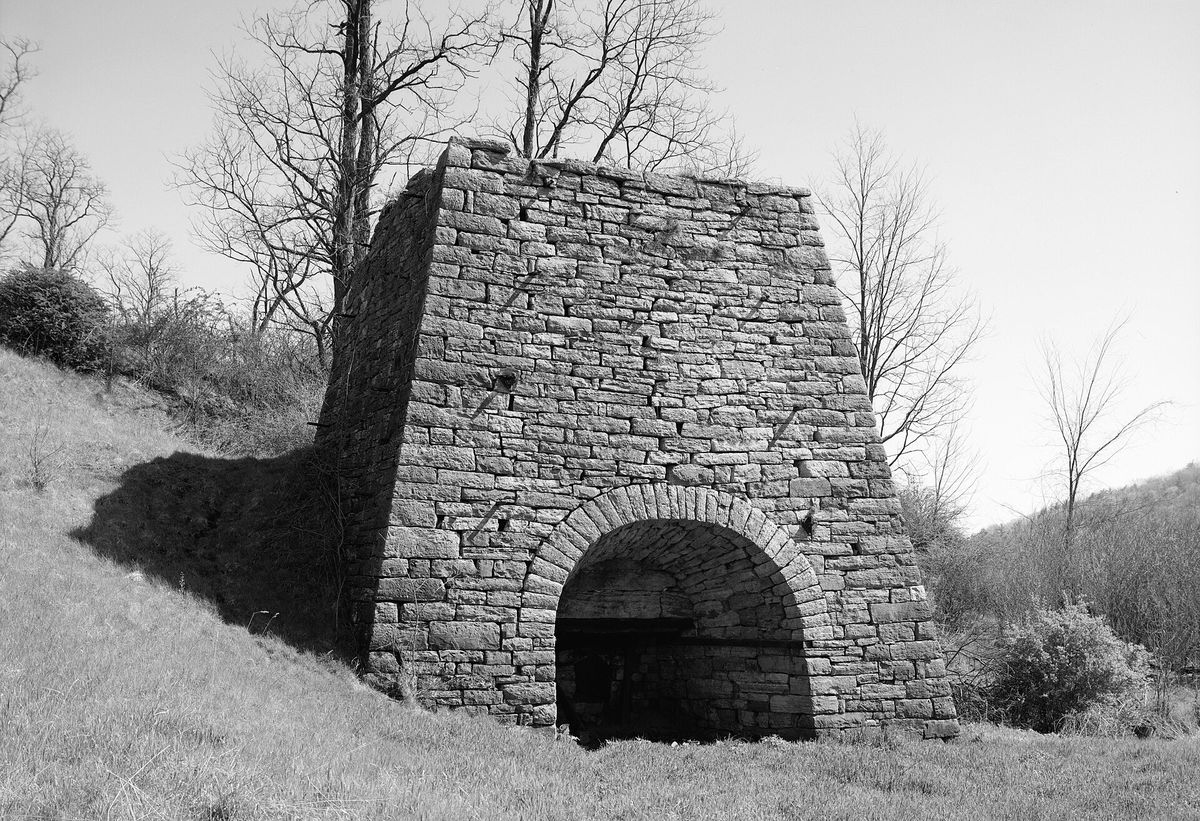
The front of the blast furnace at Huntingdon Furnace.
The front of the blast furnace at Huntingdon Furnace.Jet Lowe stg07

Did you know? The iron works in Franklin Township was not one man's idea. It took three, and each of them brought something different.

The county history says that about the year 1796 a company was formed by Mordecai Massey, Judge John Gloninger of Lebanon, and George Anshutz to put up a furnace called Huntingdon on Warrior's Mark Run. The division of labor is spelled out plainly: Massey owned the land, Gloninger put in the money, and Anshutz brought the skill, "acquired in the manufacture of iron in Europe."

The history also passes along a story it does not vouch for. "It has been said that the company commenced with one horse and a pair of oxen at the old seat."

The first location did not work. It was abandoned after some time and another furnace was built about a mile farther down the run. Martin Dubbs and George Shoenberger came into the company later, which traded as John Gloninger and Company and then as Gloninger, Anshutz and Company.

It ran on charcoal, and it kept running on charcoal until the wood ran short and the works were abandoned in 1870. Nearly three quarters of a century. The county history says it "was conducted with great prudence, and enriched its owners."

Three men, one horse and a pair of oxen, and a furnace that outlasted all of them.

Checked against the record. The post says "built in 1805." Africa 1883 says "About the year 1796 a company was formed ... to erect a furnace called 'Huntingdon,' on the Warrior's Mark Run, in Franklin township." Nine years off, and note the source's own hedge, "about the year," which the rewrite keeps. The post says it was "built in 1805 by Alsatian immigrant George Anshutz." It was built by a company of three, and Africa is unusually specific …

Read the full story, with 3 passages quoted from the county histories →

South of Route 45 in Franklin Township, on a hillock above Spruce Creek, a stone clubhouse and three stone outbuildings sit on the ten acres the Spruce Creek Rod and Gun Club bought soon after it formed. The club was formed in 1904 by Altoona businessmen who wanted a ten year lease on exclusive fishing rights over several farms along the choicest part of the creek. The first meeting, under J.G. Davis, was held at the Logan House in Altoona. The charter gave the club's purpose as the stocking and propagation of trout, and its first act was to build a hatchery beside a spring next to the land it was about to buy. The nomination says the club worked closely with the state fish hatchery at Bellefonte for fingerlings, and that this cooperation brought German brown trout into Spruce Creek. The original roll ran to 112 members, among them Oliver Rothert, W.C. Westfall and J.P. McWilliams, manager of the Logan House.

The clubhouse was designed by the Altoona firm of Schollar and Hersh, whose partners, Frederic James Schollar and Frank A. Hersh, started their practice in 1900 and went on to design Altoona's City Hall in 1925. Built of local field stone and lumber in the Colonial Revival style, it has a two and a half story main section under a gambrel roof, a recessed porch behind a rough stone arch, seven bedrooms on the second floor, and an attic with two large bedrooms holding nineteen beds.

Behind it stand a stone generator building of 1906 to 08, an ice house 23 feet square built one floor above ground and one below, and a two story stone garage and carriage man's house, 16 feet square, built in 1908 to 09 to house a vehicle for trips to the Pennsylvania Railroad at the village of Spruce Creek. A one story shed 16 by 110 feet was attached to it about 1920.

The nomination reached the National Park Service in January 1991 under Criterion C, for architecture and for entertainment and recreation, with a period of significance of 1905 to 1940. It says the club has operated continuously since it began, that both Presidents Eisenhower and Carter came to the clubhouse to fish for trout, and that Mission style furniture is still in use in the rooms. The bedrooms are named for eastern states: Pennsylvania, Delaware, New Jersey.

The Spruce Creek Rod and Gun Club, unlike the South Fork Fishing and Hunting Club in Cambria County, made no major changes to the environment. The club constructed a large clubhouse with necessary outbuildings, and hatcheries to stock the nearby stream. The Altoona businessmen did not have to rely on a manmade dam for recreation, but used a natural flowing stream as the focus of the club's activities.National Register of Historic Places nomination, Spruce Creek Rod and Gun Club (reference 91000228), 91000228, section 8, p5 · character 12,351 of the scanned text
Checked against the record. Checked against the National Register nomination text before publication; 5 claims the nomination did not support were removed or corrected.

Open this story on its own page →

Where it sits

Alexandria borough: 12 storiesBirmingham borough: 2 storiesBroad Top City borough: 2 storiesCassville borough: 2 storiesCoalmont borough: 2 storiesDudley borough: 2 storiesHuntingdon borough: 36 storiesMapleton borough: 6 storiesMarklesburg borough: 4 storiesMill Creek borough: 4 storiesMount Union borough: 137 storiesOrbisonia borough: 8 storiesPetersburg borough: 3 storiesRockhill borough: 5 storiesSaltillo borough: 5 storiesShade Gap borough: 3 storiesShirleysburg borough: 4 storiesThree Springs borough: 4 storiesBarree township: 6 storiesBrady township: 4 storiesCarbon township: 3 storiesCass township: 2 storiesClay township: 4 storiesCromwell township: 7 storiesDublin township: 5 storiesFranklin township: 10 storiesHenderson township: 6 storiesHopewell township: 5 storiesJackson township: 9 storiesJuniata township: 8 storiesLincoln township: 5 storiesLogan township: 5 storiesMiller township: 4 storiesMorris township: 2 storiesOneida township: 6 storiesPenn township: 4 storiesPorter township: 10 storiesShirley township: 10 storiesSmithfield township: 5 storiesSpringfield township: 5 storiesSpruce Creek township: 7 storiesTell township: 3 storiesTodd township: 5 storiesUnion township: 5 storiesWalker township: 9 storiesWarriors Mark township: 5 storiesWest township: 2 storiesWood township: 13 storiesHuntingdonMount UnionOrbisoniaThree SpringsPetersburgMapletonAlexandriaRockhillBroad Top CitySaltillo
10 or more4 to 91 to 3borough outline