Franklin township
Huntingdon Furnace, Ironmaster's Mansion
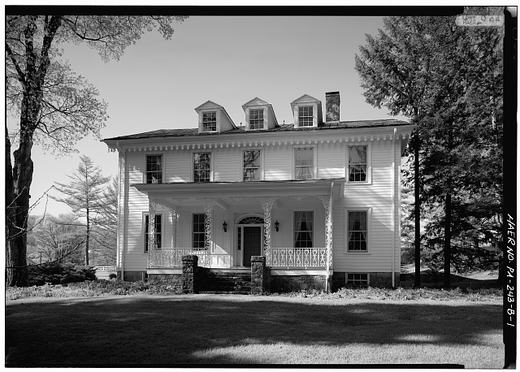
The ironmaster's mansion at Huntingdon Furnace, two miles from Colerain Mansion in the Franklinville vicinity, was photographed by the Historic American Engineering Record as HAER PA-243-B. The written history is in the parent report on the furnace, PA-243, compiled by historians Nancy Shedd and Ken Heineman, which calls Huntingdon Furnace the most extensive and best-preserved iron furnace site in the county.
The survey dates the mansion to 1851 and describes a two-story, L-shaped frame house whose front block is 50 feet wide, with five bays and three gable-roofed dormers. Its three-bay porch has a paneled ceiling and wall above wainscoting and decoratively patterned cast iron. A standing-seam metal roof overhangs intricately patterned trim that runs around the whole house, and the six-over-six windows are joined by paired round-topped attic windows in the gable ends.
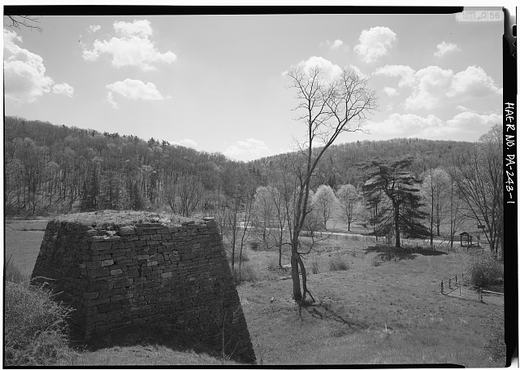
The furnace the mansion served was older by half a century. The survey says George Anshutz, an experienced ironmaker from Alsace, in France, had built the first furnace in the Pittsburgh area in 1792, which failed in part for being too far from its ore, and by 1796 had joined other investors in a furnace on Warriors Mark Run; by 1805 that first stack was abandoned and the present furnace built. J. Simpson Africa's 1883 county history tells the same story and names the partners: Mordecai Massey owned the land, Judge John Gloninger of Lebanon put in the money, and Anshutz brought the skill. In the 1830s, the survey says, the holdings passed to Peter Shoenberger, whom it calls the Iron King, and at his death in 1854 to his sons George and John. Africa says the furnace ran on charcoal until scarcity of wood led to its abandonment in 1870; the survey has it out of blast by the 1880s.
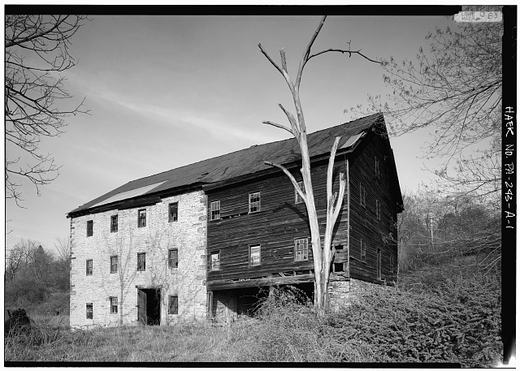
The furnace farms kept going. When the survey visited, the owner, Edward Newlin, was the latest in a long line of farmers on the property, and the grist mill of about 1808 nearby still had its overshot water wheel, of all-iron construction, fed by an iron pipe from the creek.
Sources
- Library of Congress, Historic American Buildings Survey HAER PA-243-B: Huntingdon Furnace, Ironmaster's Mansion (1991)
- HAER PA-243-B data pages (cover sheet) (1991)
- HAER PA-243 Huntingdon Furnace, written historical and descriptive data (parent report) (1991)
- History of Huntingdon and Blair Counties, Pennsylvania (J. Simpson Africa, 1883), Franklin Township chapter and iron industry chapter
Checked 2026-09-05 · Library of Congress survey record, read in full
← All stories from Franklin township
Have something to add to this story, or a photograph of it? Send it here →
Photographs from Franklin township
More from Franklin township
The Historic American Engineering Record's photographs of the ironmaster's mansion at Pennsylvania Furnace carry survey…
Franklin township, The Stone Mill at Huntingdon FurnaceThe Historic American Engineering Record photographed the grist mill at Huntingdon Furnace under survey number HAER…
Franklin township, The Lyon mansion at Pennsylvania Furnace, twenty-eight rooms of limestone on the county lineA tenth of a mile west of Route 45, just south of the Centre County line, stands an L-shaped house of native limestone…
Also about industry
The Rockhill Iron and Coal Company store stands at the corner of Main and Cliff streets in Robertsdale, opposite the…
elsewhere in the county, The company office that became the post officeThe Rockhill Iron and Coal Company office stands on the east side of Main Street in Robertsdale, just south of the East…