Franklin township
Huntingdon Furnace, an iron plantation on Warriors Mark Run
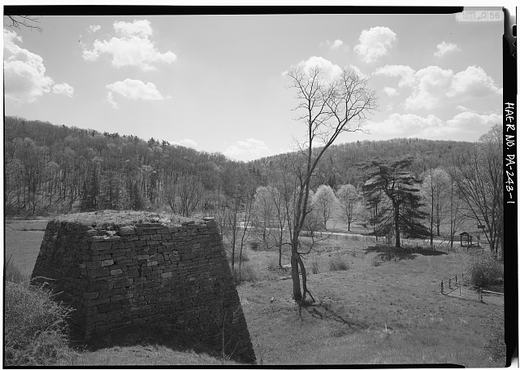
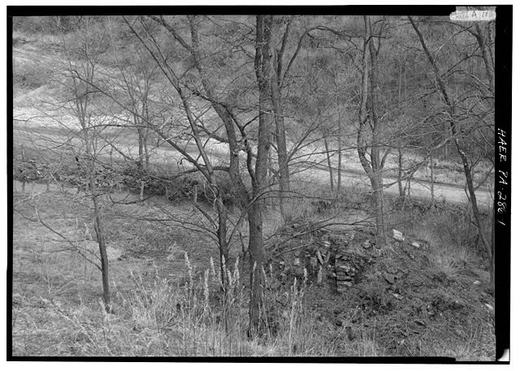
Two miles northwest of the Colerain Mansion in Franklin Township, a stone blast furnace stack stands at the bottom of a steep incline at the edge of a cow field. It measures 30 by 30 by 30 feet, built of rubble limestone and sandstone with round arched openings on the east and north faces. The National Register nomination of 1989 describes it as in excellent, original condition, still holding its tie rods with washers and wedges and refractory materials from an early date.
The nomination says the furnace was developed by George Anshutz, an ironmaker from Alsace who built Pittsburgh's first iron furnace on Two-mile Run in 1792. By 1796 Anshutz had joined John Gloninger and Mordecai Massey in a furnace on Warriors Mark Run upstream of the present site. Africa's 1883 county history adds a fourth partner, Martin Dubbs of Philadelphia, and describes the start: fifteen acres bought in 1796, a small furnace, one horse and a yoke of cattle for a working outfit. By 1805 the old seat had been abandoned and the present furnace built downstream. Trading as John Gloninger and Co., the operation reinvested its profits in timber, ore mines and farmland, and built the stone grist mill about 1808. By 1819 the holdings reached 40,000 acres, and the 1820 census of manufactures counted 206 men in the combined Gloninger enterprises.
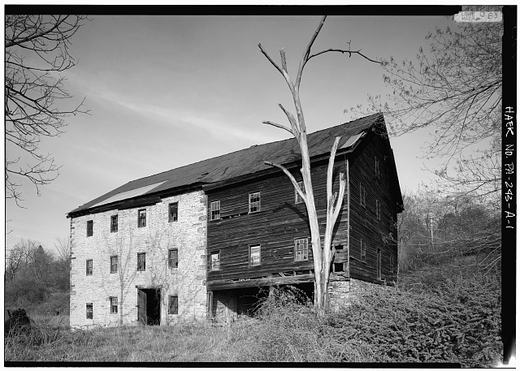
In the 1830s the property passed to Peter Shoenberger, the "Iron King," and at his death in 1854 to his sons George and John. Africa reported the furnace out of blast in 1883 and the farms in a high state of cultivation. The stone mill outlived the furnace, grinding for area farmers until about 1920. Africa records the first Sunday school in that part of the valley opening in the old stone mill about 1821.
The district was listed under Criteria A and C, industry and architecture, as a good example of an iron plantation; the nomination calls it the most extensive and best preserved iron furnace site in the county. Eight contributing resources survive: the stack, the office, the 1851 ironmaster's mansion, a log workers' house the nomination describes as the county's only known example of half dovetailed log construction, a frame farm worker's house, the farm manager's house, the grist mill and the miller's house. Africa put the furnace's output, when last in blast, at forty-five tons of iron a week.
It began as a small operation, merely 15 acres in 1796. By 1805, the "old seat" had been abandoned and the present furnace built a mile downstream.National Register of Historic Places nomination, Huntingdon Furnace (reference 90000407), 90000407, section 8, p7 · character 11,714 of the scanned text
Sources
- National Register of Historic Places nomination: Huntingdon Furnace, reference 90000407 (1989)
- J. Simpson Africa, History of Huntingdon and Blair Counties, Pennsylvania (Franklin Township chapter, Huntingdon Furnace and Sunday school passages) (1883)
Checked 2026-09-05 · National Register of Historic Places nomination, read in full
← All stories from Franklin township
Have something to add to this story, or a photograph of it? Send it here →
Photographs from Franklin township
More from Franklin township
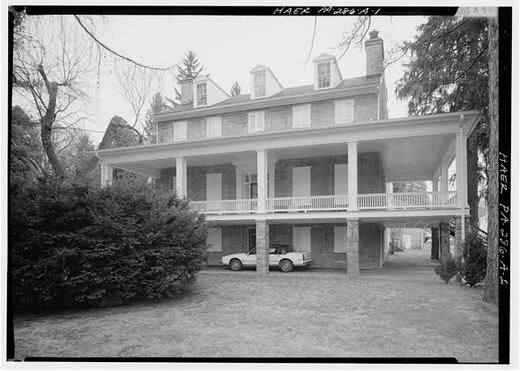
The Historic American Engineering Record's photographs of the ironmaster's mansion at Pennsylvania Furnace carry survey…
Franklin township, The Stone Mill at Huntingdon FurnaceThe Historic American Engineering Record photographed the grist mill at Huntingdon Furnace under survey number HAER…
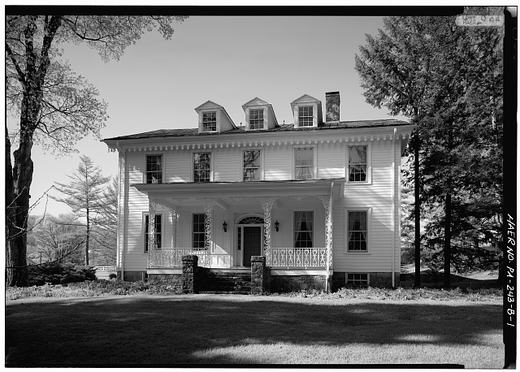
Franklin township, Huntingdon Furnace, Ironmaster's MansionThe ironmaster's mansion at Huntingdon Furnace, two miles from Colerain Mansion in the Franklinville vicinity, was…
Also about industry
The Rockhill Iron and Coal Company store stands at the corner of Main and Cliff streets in Robertsdale, opposite the…
elsewhere in the county, The company office that became the post officeThe Rockhill Iron and Coal Company office stands on the east side of Main Street in Robertsdale, just south of the East…