Huntingdon County Information Page

Borough · Huntingdon County

Mapleton

6 stories on file, each with its sources. 0.2 square miles of land in the ridge and valley country of central Pennsylvania.

418
Population
2020 Census, P.L. 94-171
0.18 sq mi
Land area
2020 Census gazetteer
0.01 sq mi
Water
2020 Census gazetteer
594 ft
Elevation
Community reference point, checked against USGS
Borough
Type
GEOID 4206147248

Nearby

Straight-line miles between map centers, 2020 Census boundary file

The founding record

The land belonged to John Donaldson, who laid out a town about the time the railroad was completed and on August 12, 1866, Mapleton was incorporated as a borough, with A. H. Bauman as the first chief burgess. A postoffice was established here at an early date. In 1876 two sand quarries were opened near the town and have added materially to its growth and prosperity. Mapleton has a tine public school building, churches of various denominations and is a place of considerable commercial activity. John W. Jordan, ed., History of the Juniata Valley and Its People (New York: Lewis Historical Publishing, 1913) · character 227,076 of the scanned text

Quoted from a work published before 1929 and therefore in the public domain in the United States. Spelling and punctuation are as printed, including nineteenth century spellings of place names. Scanned text carries optical character recognition errors; the character offset is given so the passage can be found and checked in the original.

6 stories

Stories from Mapleton

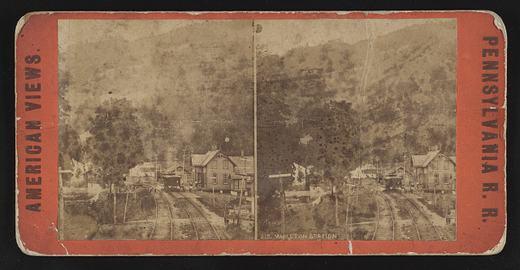
Mapleton Station
Mapleton StationLibrary of Congress, Prints and Photographs Division. No known restrictions on publication. 2017660278

A stereo card in the Library of Congress carries the words American Views. Pennsylvania R. R. on its mount, the number 219, and the title Mapleton Station. The library dates it only to between 1860 and 1890 and names no photographer. It is an albumen print from the Marian S. Carson Collection, with no known restrictions on publication.

The 1883 county history says the station came before the town. In 1851 the land was owned by M. F. Campbell and John Donaldson and had not begun to take on the character of a village. When the Pennsylvania Railroad was completed a station was established here, and that station, the history says, was the nucleus of the future village. As late as 1858 there were no more than three houses, those of George Beatty, Robert McCarl and George King. The shipping of bark, timber and sand from this point drove rapid growth between 1860 and 1866, when the population reached three hundred. A borough charter followed in August 1866, taking in about a quarter of a square mile on the southern shore of the Juniata where Scrub Run and Hare's Valley Creek enter the river. The population was 389 in 1870 and 444 at the 1880 census. The post office, the history notes, was established at an early day under the name Mapleton Depot, and Jordan's 1913 history still gives Mapleton Depot as the post office name, with a population of 752 in 1910.

Lytle's 1876 history describes glass sand being quarried and crushed on the opposite side of the river from the town, and Jordan records two sand quarries opened near it in 1876. The 1966 centennial booklet says a large passenger station and a freight station were built on the south side of the tracks in the center of town, with a passenger waiting room on the north side, and that by 1966 all of them had been torn down except the track foreman's house. The booklet also says the railroad sold its locomotive water reservoir to the borough in 1932 for fifty dollars.

American Views. Pennsylvania R. R.Library of Congress, Historic American Buildings Survey / Historic American Engineering Record, Mapleton Station, written data pages, Library of Congress item 2017660278, note on mount · character 449 of the scanned text
Checked against the record. Checked against the survey's written record before publication; 4 claims it did not support were removed or corrected.

Sources

  1. Library of Congress, Prints and Photographs Division, item 2017660278: Mapleton Station (stereograph, American Views. Pennsylvania R. R., No. 219, between 1860 and 1890)
  2. LOC item record fields for 2017660278 (data pages, D:/Projects/HuntCo/_scratch/newstories/habs/data/2017660278.txt) (1860)
  3. Africa 1883, History of Huntingdon and Blair Counties
  4. Jordan 1913, History of the Juniata Valley and its People
  5. Lytle 1876, History of Huntingdon County
  6. Mapleton Centennial 1866-1966 (in copyright; cited, not quoted)
Open this story on its own page →

Did you know? Mapleton was named by a railroad company, for trees.

The 1966 centennial history puts it plainly: when the Pennsylvania Railroad was being projected through the county, the company established a station here and "named it Mapleton because of the many huge maple trees standing in the area."

In 1851 the ground belonged to M. F. Campbell and John Donaldson, and the county history says it "had not at that time began to assume the character of a village." A town was laid out and building encouraged. It did not take.

As late as 1858 there were still only three houses standing: George Beatty's, Robert McCarl's, and George King's. That autumn A. W. Swope bought a lot and put up a dwelling, and that is what finally started other people buying and building.

Swope was a carpenter and cabinetmaker. From the time he arrived until 1871 he "put up about all the houses erected in the village during that time." One man, most of a town.

Campbell gave the borough the land for all of its churches and for the cemetery. He, Mr. Clayton and Mrs. John Donaldson built the Presbyterian church that is still in use, out of brick made in Campbell's own factory.

By 1866 the population had reached three hundred, on the strength of shipping bark, timber and sand out of that station. The borough charter was granted August 12, 1866.

If you live in old Mapleton, there is a fair chance a carpenter named Swope framed your house.

Checked against the record. It was still the wrong outcome, and it is exactly the failure negative-verdicts-need-proof warns about: cutting a true fact for lack of a source reads as discipline in the moment and as a hole in the work later. It says: "When the Pennsylvania Railroad was being projected through the county more than a century ago the company established a station here and named it Mapleton because of the many huge maple trees standi…

Open this story on its own page →

The H. O. Andrews feed mill at Mapleton.
The H. O. Andrews feed mill at Mapleton.Generic1139 stg03

In the summer of 1908 H. O. Andrews and some area farmers pooled an order and had the first rail car of feed shipped into Mapleton, a car of shelled corn. The Mapleton Centennial book of 1966 tells it that way; the nomination says he and a group of area farmers began buying feed by the rail car load. Andrews had come to Mapleton about 1903 to run a stave mill in the mountains, and the feed business grew out of the stave mill and his contracting interests.

In the spring of 1914 Andrews hired Anderson Dell to put up a mill for grinding and storing feed on the north side of West Main Street. It is a frame building forty feet by thirty five, three and a half stories tall, with wood clapboarding, a concrete block foundation and a cross gabled metal roof; a small fourth story section holds the top of the elevator. A railroad siding ran along its north side. The nomination says he soon added a coal and lumber storage shed and became a coal dealer as well; the centennial's history of the west end has him selling coal and feed there from the spring of 1908. He also installed equipment for milling flour, but the nomination says that line lasted only a few years, and the centennial book says the flour mill ran only during the First World War.

Additions followed: a two story frame addition and a run of semi-open lumber and coal bins on the east side in the 1920s, a one story addition on the west, and over the years four large frame storage sheds. In 1936 the flood put thirteen inches of water on the mill's first floor, and in 1937 a warehouse went up at the upper end of the grounds, above any flood level then known.

The nomination, prepared in November 1989, presents the property as an early twentieth century feed mill complex that still worked as a mill, under the Industrial Resources of Huntingdon County listing. By then the business was called Mapleton Farm and Garden, in the same buildings, with much of the original milling equipment still in use. The first car of grain into the new building in 1914 was shelled corn, and H. O. Andrews Sr. and W. H. Andrews Sr. unloaded it themselves with half bushel measures, carried in and dumped into the bins.

This feed and, later, flour mill developed as an outgrowth of H.O. Andrews' stave mill and contracting interests.National Register of Historic Places nomination, H.O. Andrews Feed Mill (reference 90000399), section 8, continuation page 2 (PDF page 5) · character 5,463 of the scanned text
Checked against the record. Checked against the National Register nomination text before publication; 5 claims the nomination did not support were removed or corrected.

Open this story on its own page →

Did you know? The world's largest operating steam locomotive crossed Huntingdon County this summer.

Union Pacific's Big Boy 4014 came through on Wednesday, July 8, on its east coast tour celebrating America250. The Huntingdon Daily News reported that it passed through Mount Union, Mapleton, Mill Creek and Huntingdon, where it stopped for about 10 minutes. From there it went on through Spruce Creek and then on to Tyrone. Hundreds of spectators lined the route.

Checked and confirmed. CONFIRMED 2026-10-03 against the sources listed: every factual sentence was tied to a verbatim passage and a script confirmed each passage is in its source. Where sources disagreed on a number, the number was left out. Information shared with us by readers is given as theirs, not as fact: Lynn Klingel.

Open this story on its own page →

Mapleton's Civil War veterans organised in December 1880 with twenty-one men. By the time Africa's county history went to press three years later the post had grown to forty-seven and was, in the book's phrase, in a flourishing condition. The Grand Army of the Republic was the union veterans' organisation, and a post was how a small town's survivors kept hold of one another.

Harry Corbin Post, No. 200, G. A. R. This post was organized in December, 1880, with twenty-one members. The first officers were M. L. Rex, P.-C.; A. Y. Bobb, S. V. C.; Philip Hooper, J. V. C.; H. Swope, Adjt.; J. R. Peterson, Q.M.; and John S. Henderson, Chap. The post now numbers forty-seven members, and is in a flourishing condition.J. Simpson Africa, History of Huntingdon and Blair Counties, Pennsylvania (Philadelphia: Louis H. Everts, 1883) · character 0 of the scanned text

Open this story on its own page →

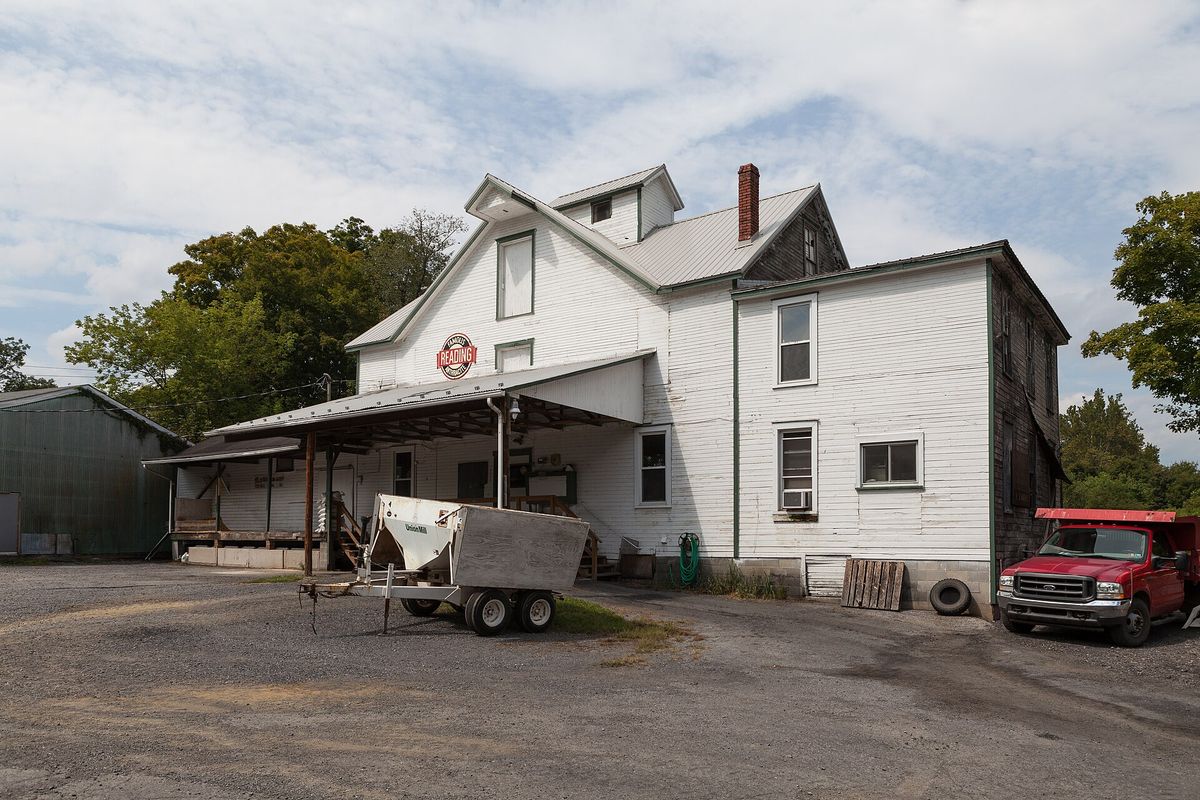
H. O. Andrews Feed Mill, a historic feed mill at Mapleton, Huntingdon County, Pennsylvania
H. O. Andrews Feed Mill, a historic feed mill at Mapleton, Huntingdon County, PennsylvaniaGeneric1139, via Wikimedia Commons. Creative Commons Attribution-ShareAlike 3.0. NRHP 90000399

A feed mill is where a farming county turns its own grain back into something its animals can eat, and Mapleton's is on the National Register of Historic Places. This is the borough's first photograph on this site other than the Grand Army post recorded in print.

Open this story on its own page →

Where it sits

Alexandria borough: 12 storiesBirmingham borough: 2 storiesBroad Top City borough: 2 storiesCassville borough: 2 storiesCoalmont borough: 2 storiesDudley borough: 2 storiesHuntingdon borough: 36 storiesMapleton borough: 6 storiesMarklesburg borough: 4 storiesMill Creek borough: 4 storiesMount Union borough: 137 storiesOrbisonia borough: 8 storiesPetersburg borough: 3 storiesRockhill borough: 5 storiesSaltillo borough: 5 storiesShade Gap borough: 3 storiesShirleysburg borough: 4 storiesThree Springs borough: 4 storiesBarree township: 6 storiesBrady township: 4 storiesCarbon township: 3 storiesCass township: 2 storiesClay township: 4 storiesCromwell township: 7 storiesDublin township: 5 storiesFranklin township: 10 storiesHenderson township: 6 storiesHopewell township: 5 storiesJackson township: 9 storiesJuniata township: 8 storiesLincoln township: 5 storiesLogan township: 5 storiesMiller township: 4 storiesMorris township: 2 storiesOneida township: 6 storiesPenn township: 4 storiesPorter township: 10 storiesShirley township: 10 storiesSmithfield township: 5 storiesSpringfield township: 5 storiesSpruce Creek township: 7 storiesTell township: 3 storiesTodd township: 5 storiesUnion township: 5 storiesWalker township: 9 storiesWarriors Mark township: 5 storiesWest township: 2 storiesWood township: 13 storiesHuntingdonMount UnionOrbisoniaThree SpringsPetersburgMapletonAlexandriaRockhillBroad Top CitySaltillo
10 or more4 to 91 to 3borough outline