Mount Union borough
The Crum Building
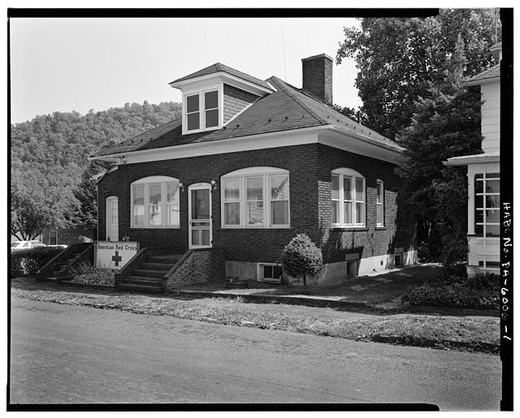
The Crum building on the corner of Jefferson Street and Railroad Avenue.
It replaced the Broad Top House, one of Mount Union's early hotels, built by James G. Doyle in the late 1850s and standing along the railroad opposite the station.
By 1909 the Crum building held a barber's room — James Nevell's, opposite the Beers Hotel — and the real estate and insurance office of McKelvy and Fields.
From the record
Passages about this subject, quoted from county histories now in the public domain. Each one names the book and the position in the text so it can be checked. Spelling is as printed.
The Broad Top House, located corner of Jefferson Street and railroad opposite depot, was built in 1858 by James G. Doyle, and now owned by his heirs. The Seibert House, located corner of Shirley and Jefferson Streets, was built in 1881 by William Seibert, present owner and proprietor. Mills and Manufactories., The pioneer gristmill, located at lower end of the borough, and run by water taken from Hi]l Valley Run, was built by the heirs of John Shaver in 1832 or 1833. It was sold but a few years since by Henry Shaver to David Etnier, who has enlarged, improved, and made it a first-class custom mill. The National Steam Grist-Mill, located on Water Street, was built in 1867 by Peter M. Bare, who ran it two years and sold to John Bare, and in 1870 John Bare sold to William Fields. Fields sold to B. J. Devor, and in 1878 he sold to W. H. Allen, the present proprietor. Mount Union is also the shipping and business point for the products of Lucy Furnace, located just head & Swoope are the owners and operators. His father, Peter Swoope, was a son of one of the early settlers of the Juniata Valley, and identified with the interests of Huntingdon and vicinity. The early educational advantages‘ of Mr. Swoope were such as the common schools' of the day afforded, and during his earlier life he performed such work as is usually provided for boys upon the farm.J. Simpson Africa, History of Huntingdon and Blair Counties, Pennsylvania (Philadelphia: Louis H. Everts, 1883) · character 2,296,488 of the scanned text
The Juniata Division of the Pennsylvania Canal was finished to this place in 1830. The pioneer hardware store at this place was established by Lieut. Frank D. Stevens in 1867, on the corner of Shirley and Jefferson Streets, where he is still conducting one of the largest and most complete stores of the kind in this section of country. He was born in Springfield township, Huntingdon Co., Pa., March 18, 1841. On his father's side his ancestors came from Scotland, while his mother's people were from Germany. Benedict Stevens, the father of Lieut. Stevens, was born in Shirley township, same county, on the 28th of February, 1802. He grew to manhood on his father's farm in Shirley township, and eventually became 357 himself a farmer. He married, Oct. 8, 1822, Miss Eve Orr, and they became the parents of eight sons and seven daughters, of whom nine are now living. Five of the sons were in the Rebellion, serving from two to three years. Mrs. Stevens, after a long and well-spent life, passed away on the 31st of December, 1882, at the village of Three Springs, Clay township, where Benedict Stevens still resides. For more than half a century they have been members of the Metbodist Episcopal Church. He is a local preacher, and without charge preaches the gospel of peace. Frank D. was the twelfth child, and being one among so many had only the advantages of the common schools and two terms at the Rainsburg (Bedford County) Academy.J. Simpson Africa, History of Huntingdon and Blair Counties, Pennsylvania (Philadelphia: Louis H. Everts, 1883) · character 2,308,233 of the scanned text
It was used from 1842 until the present court-house was built. About 1876 it became apparent that the court-house was inadequate to the needs of the county, and the question of making additions and repairs came up for consideration. Successive grand juries recommended the erection of a new building, and on April 21, 1882, the commissioners passed the following resolution : "In order to carry out the instructions of the grand juries in the matter of repairing and remodeling the court-house, it was unanimously resolved to issue bonds to an amount not exceeding seventy-five thousand dollars, interest payable at four per cent, per annum, dale of issue June i, 1882. The above resolution to be presented to the court for approval." The court approved the action of the commissioners, and on April 28, 1882, the plans submitted by M. E.John W. Jordan, ed., History of the Juniata Valley and Its People (New York: Lewis Historical Publishing, 1913) · character 121,482 of the scanned text
Checked 2026-09-09 · Historic Mount Union collection
← All stories from Mount Union borough
Have something to add to this story, or a photograph of it? Send it here →
Photographs from Mount Union borough

More from Mount Union borough
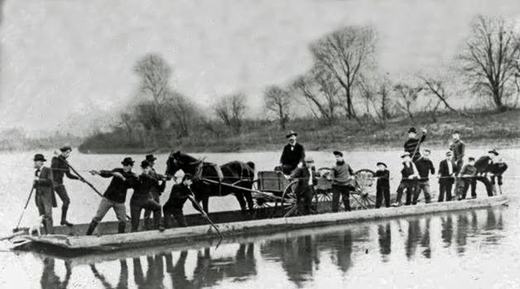
Did you know? The crossing at Drake's Ferry, just above Mount Union, went from a ferry to a series of bridges. Samuel…
Mount Union borough, The darkest day: February 27, 1917February 27, 1917, eight minutes past midnight. The eastbound Mercantile Express, Pennsylvania Railroad train No. 6 out…
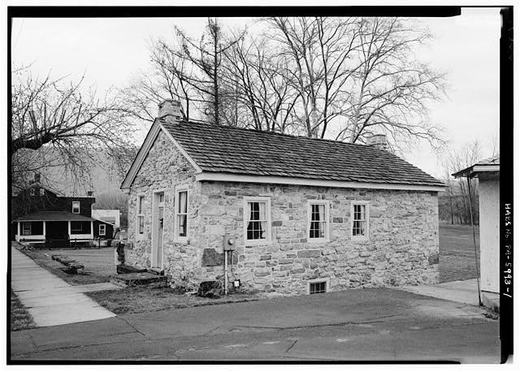
Mount Union borough, A Question We Cannot Settle, and Maybe You CanThis stone house stands on West Water Street near Division. The federal survey records it as the John Sharrar House and…