Mount Union borough
The Creosoting Plant
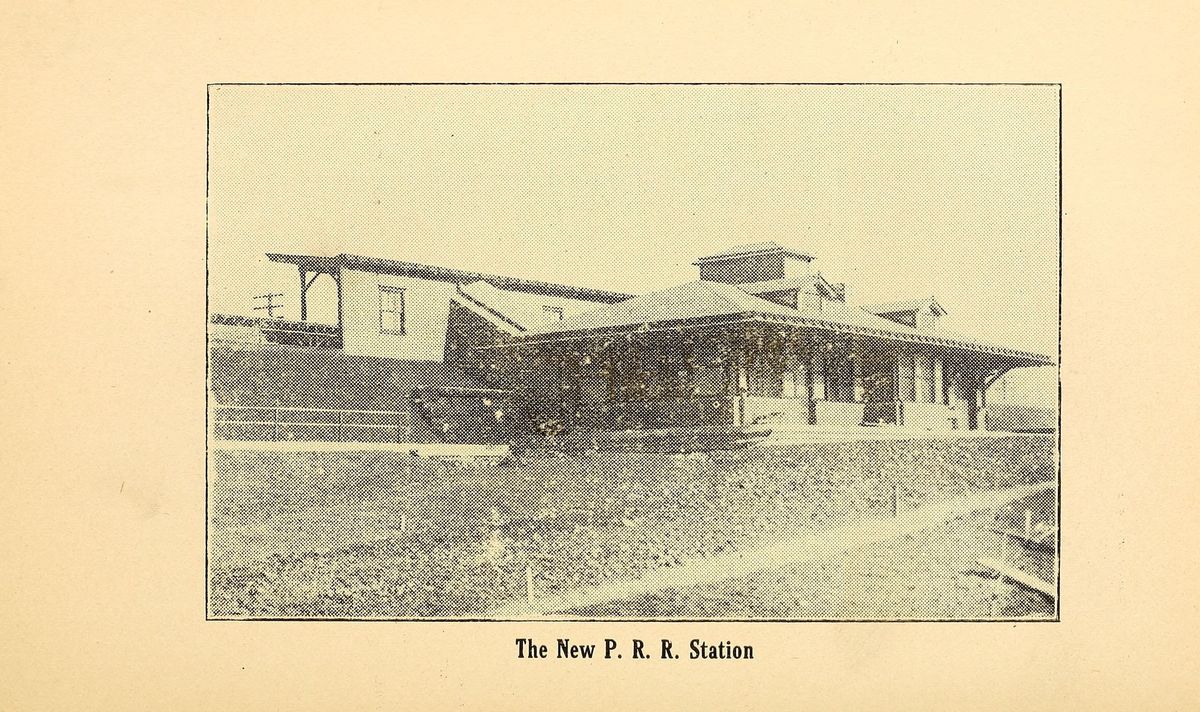
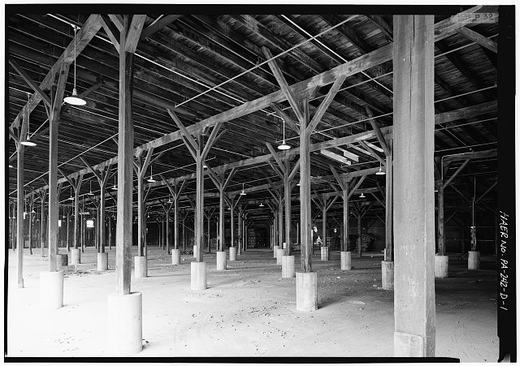
The Pennsylvania Railroad's tie-treating plant, on the company's ground northeast of town along the Juniata.
Charles H. Welch was writing in 1909, when it was brand new. He calls it “Mount Union's latest industry”, put up by the railroad during the previous year and opened only months before he wrote.
The numbers he gives are the ones worth keeping. Seven thousand gallons of creosote used every day, imported from Europe, stored in tanks at Philadelphia and shipped up here. Two thousand feet of siding in and around the works. Two thousand ties treated a day, and half a million ties lying on hand. About fifty men employed, under Superintendent Carl W. Tiffany.
And Welch adds something he is careful about: so far as he could learn, treating ties with creosote was “somewhat of an experiment”, and this was the first plant of its kind the Pennsylvania Railroad had built.
From the record
Passages about this subject, quoted from county histories now in the public domain. Each one names the book and the position in the text so it can be checked. Spelling is as printed.
North of the original works a new establishment was started in November, 1868, for the manufacture of steel by the Bessemer process, but it was discontinued the succeeding year. In 1871 William Butcher, of Philadelphia, bought the plant and began the manufacture of steel tires, but became financially embarrassed and turned the works over to his creditors, who organized the Standard Steel Company, and the village later came to be called Burnham, after one of the head men of the Standard Company. At the January sessions of the court in 191 1 a petition was presented asking for the incorporation of Burnham as a borough, and on June 26, 1911, the court granted the prayer of the petitioners, fixed the boundaries and ordered an election for the 20th of July following. At the election R. L. Eward was elected chief burgess ; A. M. Plank, tax collector ; J. L. Groninger, constable; Miller Leeper, Cloyd Williams, David Thomas, A. K. Andrews, John Ward, Albert Reich and Frank Broome, councilmen. Bumham is a station on the Milroy branch of the Pennsylvania railroad, four miles north of Lewistown, with which it is connected by electric railway. Granville, a station on the main line of the Pennsylvania railroad, takes its name from old Fort Granville.John W. Jordan, ed., History of the Juniata Valley and Its People (New York: Lewis Historical Publishing, 1913) · character 350,789 of the scanned text
Swan, widow of Thomas Swan, who was reported among the missing by Colonel John Armstrong after his expedition to Kittanning, warranted 103 acres in 1762 and an additional sixty-eight acres the following March. The latter tract became known as the "Deep Spring Plantation," Few settlements of a permanent character were made until about 1767, owing to the hostility of the Indians. Among those who came in 1767 were Thomas Kerr, John Gray, John Potts, William Beale, Joseph Scott, Joseph Scott, and John Morrison. Stephen and Robert Porter had come into the township the preceding year, and in 1768-69 the population was increased by the arrival of Alexander Potts, Daniel Campbell, Jonathan Taylor, Jane Campbell, and some others, William Arbuckle, Thomas Martin, Samuel Finley, James McLaughlin, John Hamilton, John and Samuel Martin had all taken up lands prior to the Revolution. After the Revolution the fertile valleys of Tuscarora township received their share of the emigrants who came westward on the tide of emigration. One of the first schools was taught by James Butler near McCoysville in 1807. John Erskine taught near Reed's gap, and in 1812 a man named Gardner opened a school near Anderson's fulling mill. It is said that he treated his pupils to whisky and sugar. After the public school system came in the township was divided into ten districts.John W. Jordan, ed., History of the Juniata Valley and Its People (New York: Lewis Historical Publishing, 1913) · character 427,346 of the scanned text
The East Broad Top railroad connects with the Pennsylvania railroad at Mount Union and runs south through Shirleysburg, giving the township and outlying region ample transportation facilities. Smithiield is one of the newer townships of the county, having been organized in March, 1886, from Porter, Walker, and Juniata. It lies directly across the Juniata river from Huntingdon borough, the village of Smithfield forming practically a suburb of the county seat. The Huntingdon & Broad Top railroad runs southwest through the township. Springfield township, located in the southern part of the county, was organized in December, 1790, from the townships of Dublin and Shirley. Its original area has been much reduced by the erection of Cromwell in 1836 and Clay in 1845. It is bounded on the north by Cromwell ; on the east by Dublin ; on the south by Fulton county, and on the west by the township of Clay. John Bailey, a Revolutionary soldier, settled on the banks of the Aughwick creek soon after that war. He was soon joined by William Jones, John Robertson and William Ward. Then came a tide of immigration from Maryland, the Browns, Maddens, Ramseys, Lanes, Cutshalls, Wibles, and several other families locating in what is now Springfield township.John W. Jordan, ed., History of the Juniata Valley and Its People (New York: Lewis Historical Publishing, 1913) · character 200,911 of the scanned text
Checked 2026-09-09 · Historic Mount Union collection
← All stories from Mount Union borough
Have something to add to this story, or a photograph of it? Send it here →
Photographs from Mount Union borough

More from Mount Union borough
Did you know? The crossing at Drake's Ferry, just above Mount Union, went from a ferry to a series of bridges. Samuel…
Mount Union borough, The darkest day: February 27, 1917February 27, 1917, eight minutes past midnight. The eastbound Mercantile Express, Pennsylvania Railroad train No. 6 out…
Mount Union borough, A Question We Cannot Settle, and Maybe You CanThis stone house stands on West Water Street near Division. The federal survey records it as the John Sharrar House and…