Mount Union borough
The beehive ovens
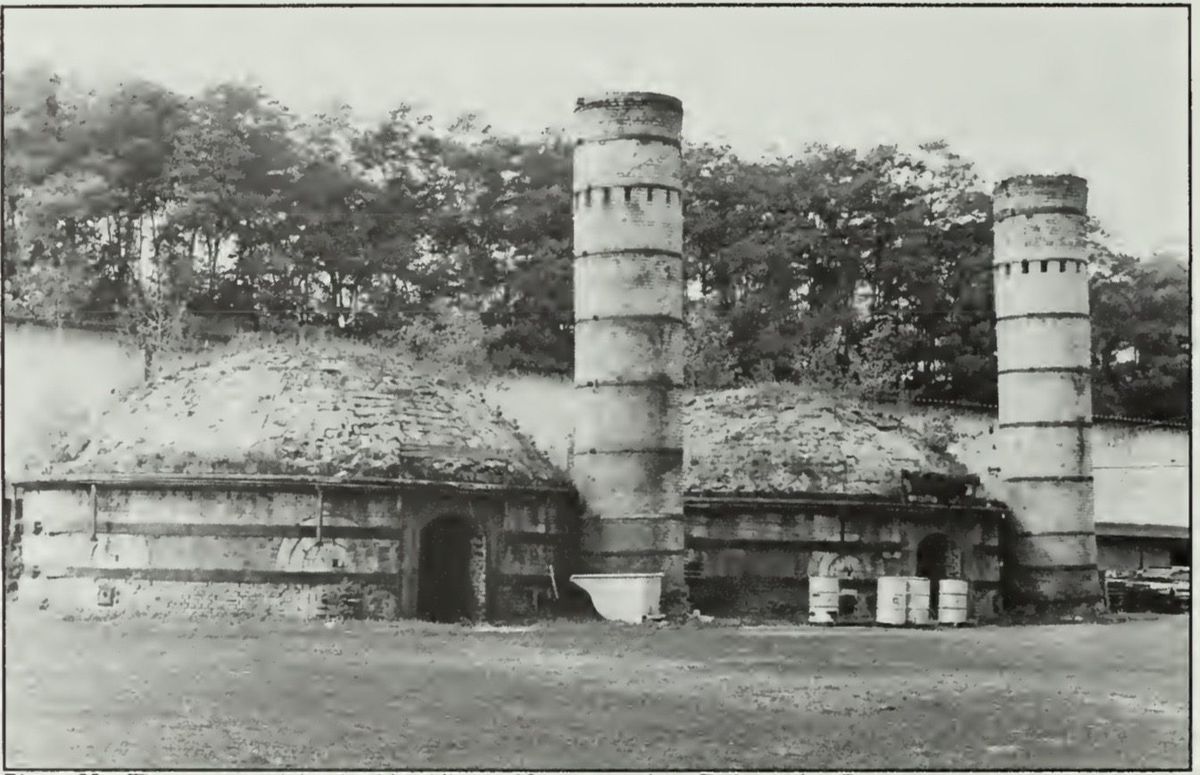
The beehive kilns of the Mount Union Refractories Company. The company was organized in 1911 and finished its silica brick plant in 1912, the third refractory concern to open in Mount Union in less than fifteen years.
Being last to arrive cost it. The two older companies had already taken the closest ganister, so Mount Union Refractories had to work quarries farther out, at Three Springs, and the East Broad Top Railroad hauled the rock in and the Broad Top coal that fired the kilns.
Then the war came. By 1919 the plant had gone from eight kilns to twenty-nine and was working 885 men. The housing shortage that followed is why the company hired the noted designer John Nolen to lay out the town of Kistler across the river.
Between the three plants, Mount Union claimed to be the silica brick capital of the world.
It is worth knowing how it ended. The company built a fireclay plant in Clearfield County in 1922 and became U.S. Refractories, merged into North American Refractories in 1930, and stopped making brick here for good in 1990. The site was put on the National Register, and then a salvage company took the buildings down and sold them for scrap. A state surveyor walked the ground on 3 April 1996 and found three buildings left. That June the Bureau for Historic Preservation wrote that the property had lost the very qualities that got it listed, and began the process of striking it off the Register. The two beehive kilns are gone.
From the record
Passages about this subject, quoted from county histories now in the public domain. Each one names the book and the position in the text so it can be checked. Spelling is as printed.
Other Huntingdon manufactories are turning out iron wares, sewer pipes, etc., but perhaps the business that has done more than any other to advertise Huntingdon to the outside world is the J. C. Blair Company, manufacturing stationers. John C. Blair, the founder of the business, was the first man in the world to put up stationery in the form of tablets, to which he soon after added the decorated covers. He began in 1878 in a small store room at 422 Penn street, which was abandoned in 18S1 for the old Presbyterian church. Three years later a five-story brick building was erected at Sixth and Allegheny streets, and in 1889 an eight-story building was put up and in May, 1891, the business was incorporated. The company employs about 250 people and its annual product reaches about $1,000,000, the Blair tablets going all over the world. A recent industry of the Juniata valley that is attracting considerable attention is the Suskana Silk Works of Lewistown, which were established in 1909. The plant at this point is one of a chain of six mills in the United States, the others being in New York City, two at Sunbury, Pennsylvania, Marion, Ohio, and Jersey Shore, Permsylvania. The business was originally established in Germany about 1784 and this branch of the silk manufacturing industry is controlled by the Schniewind family, which also has eight mills in Germany.John W. Jordan, ed., History of the Juniata Valley and Its People (New York: Lewis Historical Publishing, 1913) · character 747,046 of the scanned text
Its founder, John Chalmers Blair, engaged in the business of books and stationery in the borough between the years of 1865 and 1878. During the summer of the year last named, believing that writing and print papers could be marketed to better advantage when put up in tablet form, as against the loose, or folded, sheets, he made a number of varieties as an experiment. Knowing the power of printer's ink, these pioneer tablets were advertised to the stationery trade, and met with a cordial reception. A little later on, noticing some colored lithographic signs in a furniture store window, he conceived the idea of adding a decorated cover to the here-to-fore plain tablets. Trying out this plan proved a great success and the little store room "in the Diamond" at 422 Penn street was abandoned in 1881 for the Presbyterian church building at Sixth and Penn. Out-growing this, in turn, the large five-story brick building at Sixth and Allegheny streets was built and occupied during 1884. Then the foundation and a part of the walls of the old church were included, during 1889, in the eight-story brick building which covers one hundred foot frontage on Penn street.Historic Huntingdon, 1767-1909 · character 305,399 of the scanned text
The only private schools now in existence in the county are the Huntingdon Academy and the Mountain Seminary at Birmingham. The former was incorporated by Act of Assembly of March 19th, 1816, which also granted a donation of $2,000 to the institution. It continued to receive State aid for a number of years. The buildings, then situated at the southeastern corner of Second and Allegheny streets, known as Dean's Hotel, were purchased, and used for the school for many years. The brick building at the corner of Fourth and Moore streets was erected in 1844, and the school removed there. In 1874 a more commodious structure was placed at the northeastern corner of Fourth and Church streets. Professor J. A. Stephens was then the principal, and it was his efforts and energy that secured its erection. His health failing, he was able to teach but a short time in the new building. He died in April, 1876, much lamented by all who knew him. W. Campbell is the present principal. The Mountain Seminary was incorporated in 1851, and the buildings erected by a stock company. Rev.Milton Scott Lytle, History of Huntingdon County (Lancaster: William H. Roy, 1876) · character 343,633 of the scanned text
Sources
- Mount Union Refractories Company: National Register nomination (1989, Deborah L. Suciu) bound with the PHMC re-evaluation letter and reconnaissance survey of 17 June 1996 that removed it from the Register (NARA RG 79, NPS withdrawn nominations, ref. 90000398), Pennsylvania Historical and Museum Commission, Bureau for Historic Preservation, via the U.S. National Archives (1989, 1996)
- Mount Union Has Model Village: Built by Refractories Company For Employes; Harrisburg Man Interested, Harrisburg Telegraph, Harrisburg, Pa., July 18, 1916, page 5 (1916)
- Mount Union industry survey naming R. P. M. Davis president and general manager, F. D. Halstead secretary and treasurer, C. V. Hackman superintendent, with plant capacity and the Three Springs and Jacks Mountain quarries, Harrisburg Telegraph, Harrisburg, Pa., October 21, 1916, page 6 (1916)
- State charters issued: Mount Union Refractories Company, Mount Union, brick and tile; capital $300,000, The Fulton County News, McConnellsburg, Pa., September 21, 1911, page 2 (1911)
Checked 2026-09-09 · Historic Mount Union collection
← All stories from Mount Union borough
Have something to add to this story, or a photograph of it? Send it here →
Photographs from Mount Union borough

More from Mount Union borough
Did you know? The crossing at Drake's Ferry, just above Mount Union, went from a ferry to a series of bridges. Samuel…
Mount Union borough, The darkest day: February 27, 1917February 27, 1917, eight minutes past midnight. The eastbound Mercantile Express, Pennsylvania Railroad train No. 6 out…
Mount Union borough, A Question We Cannot Settle, and Maybe You CanThis stone house stands on West Water Street near Division. The federal survey records it as the John Sharrar House and…