Mount Union borough
Mount Union Refractories: listed in 1990, gone by 1996
The Mount Union Refractories Company plant stood on a triangular plot at the east end of Pennsylvania Avenue, between a Pennsylvania Railroad spur, the East Broad Top Railroad yards and the Juniata River. The nomination, prepared by Deborah L. Suciu in August 1989 from Nancy Shedd's 1988 Historic American Engineering Record report, put it on the National Register in 1990. Six years later the state asked to take it off.
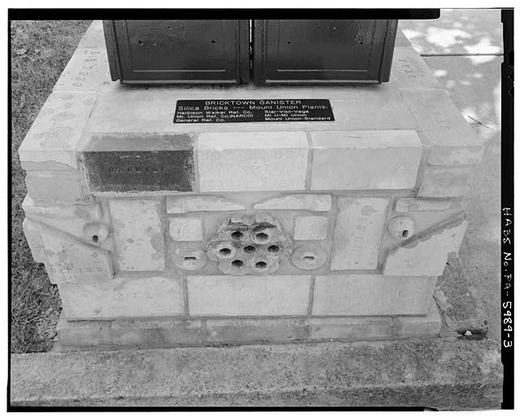
The company was organized in 1911 and finished its silica brick plant in 1912, the third such concern to open in Mount Union in less than fifteen years, after Harbison-Walker and Mount Union Silica Brick. The nomination says the three plants' total production led to the town's claim that it was the silica brick capital of the world. Arriving last, the company had to quarry its ganister rock farther off, at Three Springs, and the East Broad Top hauled it in along with Broad Top coal for the power plant and kilns.
The First World War built it up. By 1919 the plant had grown from eight kilns to 29 and employed 885 men, and the company hired John Nolen to design the company town of Kistler across the river in Mifflin County. A two-story brick office, 30 by 30 feet with pine floors, went up in 1916. In 1922 the firm built a fireclay plant in Clearfield County and became U.S. Refractories; a 1930 merger made it North American Refractories, NARCO. The nomination puts employment at 400 to 500 by 1930. The East Broad Top closed in 1956. The kilns were razed about 1980, two spared out of sentiment. In 1988 fifty-seven employees made specialty refractories for electric steel furnaces, with Bethlehem Steel the largest customer. Production stopped in 1990.
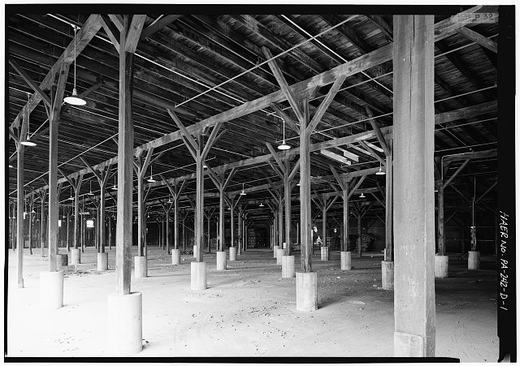
"At the time of its listing in 1990, it retained strong integrity, and its original configuration of storage sheds, production buildings, and office was intact" (removal report, p3). After the shutdown a salvage company began dismantling the buildings for scrap. When Scott D. Heberling walked the site on April 3, 1996, the office, production building, boiler house, maintenance building, both kilns and most of the sheds were gone. Two pre-1939 storage sheds and a 1981 metal addition remained. The state requested removal on June 21, 1996 under 36 CFR 60.15. The last two sheds were scheduled to come down by that summer.
At the time of its listing in 1990, it retained strong integrity, and its original configuration of storage sheds, production buildings, and office was intact.National Register of Historic Places nomination, Mount Union Refractories Company (reference 90000398), removal report (Heberling, 1996), p3 · character 5,121 of the scanned text
Sources
- National Register of Historic Places nomination: Mount Union Refractories Company, reference 90000398 (1989)
- Huntingdon County, Pennsylvania: An Inventory of Historic Engineering and Industrial Sites (Nancy S. Shedd, National Park Service, 1991), refractory brick industry and Mount Union Refractories entries
Checked 2026-09-05 · National Register of Historic Places nomination, read in full
← All stories from Mount Union borough
Have something to add to this story, or a photograph of it? Send it here →
Photographs from Mount Union borough
More from Mount Union borough
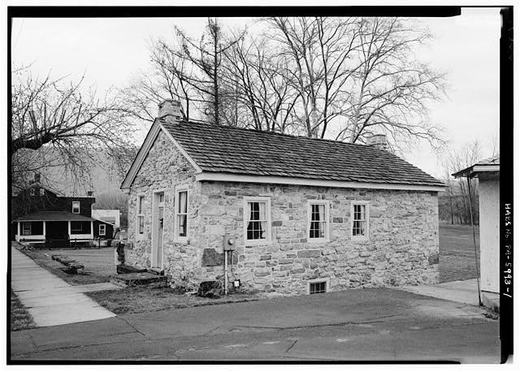
This stone house stands on West Water Street near Division. The federal survey records it as the John Sharrar House and…
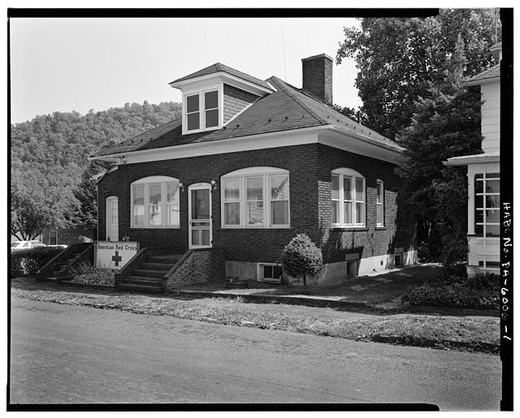
Mount Union borough, The Brick Office that Became the Red CrossLook at the sign in the yard. This little brick building on Market Street was the General Refractories Company office.…
Mount Union borough, Aetna Explosion 1916Did you know? The building that killed six men at Mount Union had been catching fire all summer, and the paper reported…
Also about industry
The Rockhill Iron and Coal Company store stands at the corner of Main and Cliff streets in Robertsdale, opposite the…
elsewhere in the county, The company office that became the post officeThe Rockhill Iron and Coal Company office stands on the east side of Main Street in Robertsdale, just south of the East…