Mount Union borough
Mount Union Historic District
The Mount Union Historic District covers about 32 square blocks centered on Jefferson and Market Streets, more than two thirds of the borough, and takes in 645 resources, 572 of them contributing buildings, as the nomination counted them in 1994. The nomination reads the town in three eras: the Canal Era from 1831 to 1850, the Railroad Era from 1850 to 1900 and the Refractories Era from 1900 to 1944.
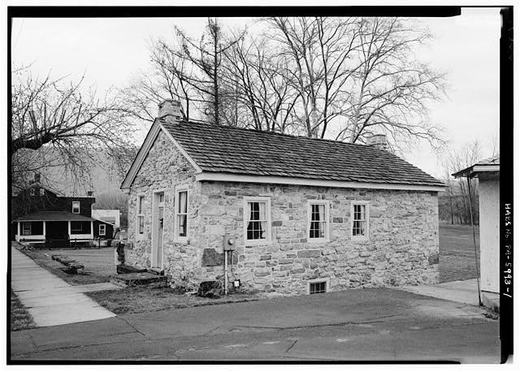
The period of significance begins in 1841 with the John Sharrar House on Water Street, which the nomination calls the district's oldest resource, though it also describes the John Shaver House, an 1818 stone house, as older. Charles Howard Welch's history of the town, printed in 1909 and 1910, says the stone house was built by John Sharrar in 1841 and that the first survey, made that year by Col. William Pollock for Sharrar, might be said to have been the nucleus of the town. The town plan came in 1849, when John Dougherty and George W. Speer laid out about eight square blocks of their own land around Pennsylvania Avenue and Washington Street, with the avenue reserved for the railroad due the next year. Welch says Dougherty, with Speer, was instrumental in laying out the town, getting a charter and naming the streets.
The nomination says the East Broad Top Railroad's 1873 connection made Mount Union a transfer point between narrow and standard gauge for coal, pig iron, ore and passengers, and the population doubled between 1870 and 1900. Then came the brick plants: the W. H. Haws Fire Brick Company in 1899, bought out after a year by Harbison-Walker of Pittsburgh; Mount Union Silica Brick in 1901; and Mount Union Refractories in 1911 and 1912. The brick companies, the nomination says, probably became the town's largest single developers of housing once they needed to house workers in the 1910s; Harbison-Walker's 100 houses on Ganister Hill were demolished in the early 1950s.
Growth after the early 1920s was limited, and the nomination credits that slowdown with leaving the pre-1920 town largely intact. The district was listed under Criteria A and C for community development, industry, transportation, commerce and architecture. The 1936 post office at Jefferson and Market has yellow brick walls the nomination likens to the mottled yellow of refractory brick, and a lobby mural of the Harbison-Walker plant painted that year by Paul Rohland.
To provide some context for the refractories' local impact, Mount Union's population in 1906 stood at 1,086. By 1910, when only two refractories operated, the population had more than tripled to 3,338. By 1920, following the tremendous growth caused by the opening of Mount Union Refractories in 1911-12 and a government-sponsored munitions plant in 1915, the population had risen to over 6,000.National Register of Historic Places nomination, Mount Union Historic District (reference 94000516), Section 8 page 4 (PDF page 19) · character 55,740 of the scanned text
Sources
- National Register of Historic Places nomination: Mount Union Historic District, reference 94000516 (1994)
- Charles Howard Welch, History of Mount Union, Shirleysburg and Shirley Township (1909), John Sharrar house and John Dougherty sketch, pp. 149-150 (corpus lines 6328-6350, 7160-7172)
Checked 2026-09-05 · National Register of Historic Places nomination, read in full
← All stories from Mount Union borough
Have something to add to this story, or a photograph of it? Send it here →
Photographs from Mount Union borough
More from Mount Union borough
This stone house stands on West Water Street near Division. The federal survey records it as the John Sharrar House and…
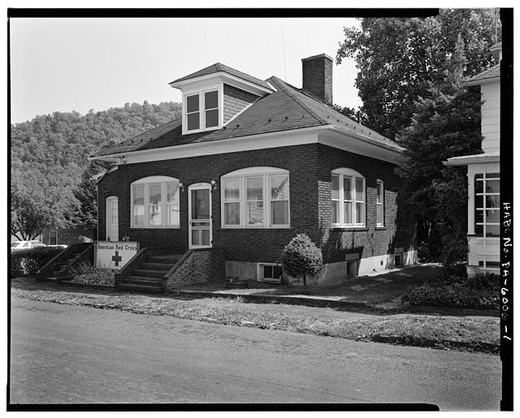
Mount Union borough, The Brick Office that Became the Red CrossLook at the sign in the yard. This little brick building on Market Street was the General Refractories Company office.…
Mount Union borough, Aetna Explosion 1916Did you know? The building that killed six men at Mount Union had been catching fire all summer, and the paper reported…
Also about community