Shirleysburg borough, Shirley township
Fort Shirley: the garrison, the threats and the march to Kittanning
George Croghan stockaded his trading post at Aughwick in September 1755, and it became a provincial post that December when he took a captain's commission. Governor Robert Hunter Morris named it Fort Shirley in January 1756, for General William Shirley, recently placed in command of the British forces in North America. He told the general it was a fort "which I have taken the Liberty to Honour with the name of Fort Shirley." Shirley Township and the borough of Shirleysburg took their names from it.
The Provincial Council's minutes set garrisons ranging from seventy-five men down to twenty, according to the situation and importance of each place. William A. Hunter's history of the Pennsylvania forts, published by the state in 1960, says an order of March 25, 1756, reduced this garrison to sixty. Captain Hugh Mercer took over from Croghan that spring, and in April he wrote the governor from Carlisle, where he had gone to recruit. The commissary sent to pay the men had come, he said, "when the greater part of our Men were about to abandon the Fort for want of Pay." He was filling his company up to sixty. For the moment, "A Garrison of thirty Men are now att Fort Shirley," engaged to stay until the first of May.
Threats came close. About January 27, 1756, a servant of Croghan's named John Baker was seized out of sight of the fort and carried to Kittanning. He escaped in March, and Hunter says he brought home the information behind that fall's attack on Kittanning. That June the French governor was told that a party of seven Frenchmen and twenty Indians could not get as near the fort as had been recommended. In August, Colonel John Armstrong reported that a soldier who had escaped after the fall of Fort Granville had heard the enemy meant to attack Fort Shirley with four hundred men.
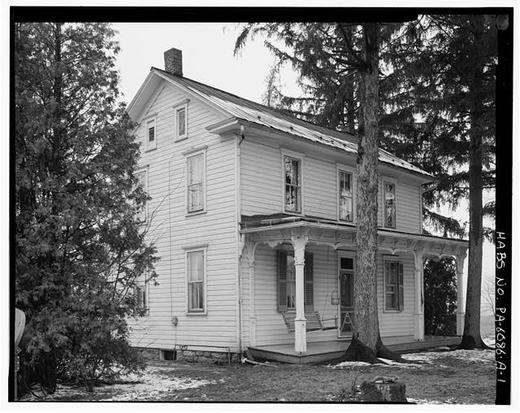
The 1996 Historic American Buildings Survey report on the Walker farmstead south of Shirleysburg says Fort Shirley "was never attacked," and Hunter says it had "the good fortune to escape" attacks like those on Granville and Patterson's, though "incidents were not lacking." Jones's 1856 history gives the other side: tradition told of "one or two very serious battles" in Aughwick after the fort went up, but the accounts were so vague that he could give nothing reliable about them.
Armstrong had his doubts about the place. Writing from Carlisle on August 20, 1756, he called it "not easily defended," with its water at the foot of a high bank and no well dug, but said he could not evacuate it without orders. First it had a job to do. It was the rendezvous for his expedition against Kittanning, and his own report has the force marching from Fort Shirley on August 30. They struck Kittanning at daybreak on September 8 and killed Captain Jacobs, the chief. Prisoners told Armstrong that French and Indians were to join Jacobs that very day and set out the next morning to take Fort Shirley, "or as they called it, George Croghan's Fort."
The gates had been taken off when the force left, and the fort stood open. Lieutenant Governor William Denny, who had succeeded Morris, told the Council on October 15 that Fort Shirley was "evacuated by his Order," and he wrote to Thomas Penn in November that he had ordered it destroyed. The name outlasted the post. In September 1763 Armstrong's men assembled at Fort Shirley for an expedition to the Big Island, near present Lock Haven. In August 1775 the Rev. Philip Fithian reached the home of a Mr. Fowley, "who lives within the walls of old Fort Shirley."
Sources
- William A. Hunter, Forts on the Pennsylvania Frontier, 1753 to 1758, 1960, pp. 394 to 405: naming, garrison, Mercer, threats, evacuation and 1763
- J. Simpson Africa, History of Huntingdon and Blair Counties, 1883, pp. 18, 46 and 341: naming, Mercer's thirty men, Denny and Fithian's visit
- Milton Scott Lytle, History of Huntingdon County, 1876, pp. 64 to 69: Morris's letter, Mercer's letter and the Kittanning march
- Minutes of the Provincial Council of Pennsylvania, Colonial Records vol. 7, 1851, pp. 19 to 278: Morris, Armstrong and Denny on the fort
- Historic American Buildings Survey, Walker Farmstead, HABS No. PA-6086, April 1996, p. 2: never attacked, 1756 and 1763
- History of the Early Settlement of the Juniata Valley, Jones, 1856, p. 159: the tradition of battles in Aughwick
- John W. Jordan, History of the Juniata Valley and its People, 1913, p. 231: Morris's letter dated January 29, 1756
Checked 2026-11-01 · Primary sources and the Pennsylvania Newspaper Archive
← All stories from Shirleysburg borough
Have something to add to this story, or a photograph of it? Send it here →
Photographs from Shirleysburg borough
More from Shirleysburg borough
An act of 6 May 1850 provided for a county house for the employment and support of the poor. It named eleven…
Mount Union borough, John S. Morrison, the Name on the ScholarshipThe John S. Morrison Scholarships were created by Oliver L. Etnier, and Mount Union Area High School's guide says he…
Mount Union borough, Mount Union's Boy Who Became Mayor of DenverRobert Walter Speer, three times mayor of Denver, grew up in Mount Union. He was born on December 1, 1855. Welch's 1909…
Also about County history
Before he wrote his history of Mount Union, Charles Howard Welch brought out a book of poems. The title page reads A…
elsewhere in the county, A Police Escort Home From WildwoodIn March 2015 the Huntingdon Daily News told readers about Darkhorse Percussion, an independent indoor percussion group…