Brady township, Mapleton borough
A Light on Rocky Ridge, 1889
According to the 1889 reprint of U. J. Jones's history of the early Juniata Valley, the Local News of Huntingdon published a strange account in February 1889 from a ridge a short distance west of Mapleton. For about twenty-five years, it is said, a peculiar light had been seen near the top of Rocky Ridge at Bridgeport. Those who saw it thought it a strange place for a light but never thought it worth looking into. Then three Mapleton men set out to find the cause.
They left Mapleton in the evening. Nearing the spot, they saw three lights that looked like rockets. Each popped up from the ground, stayed about three feet above the surface for a few minutes, and disappeared in turn, and the three seemed to point to a larger, brighter light, like a lantern's, swaying over a crevice in the rock. The place was easier to reach by day and without snow and ice on the rocks, so they came back by daylight with picks and shovels.
Six feet down they struck a pile of loose stones covering two large flat stones that formed a lid. Under it, in a hole about three feet long, was what seemed to be the remains of a human body. The men were of the opinion that someone had been murdered near the place many years before and the body hidden there. The account says the light had disappeared since the discovery and that its cause was as much a mystery as ever. It asks whether it could be explained "upon any scientific, psychological, or mythological theory."
The reprint then offers a name. "It is now conceded by many," it says, that these were the remains of Jack Armstrong, the Indian trader killed with his two companions in the Narrows about the middle of February 1744, "just one hundred and forty-five years ago." It names none of the many. The reason it gives is distance: John Harris's memorandum fixes the killing eight miles from Aughwick and ten from Standing Stone, "which is about the spot where the body was recently found."
On March 7, 1889, the Bellefonte Republican passed along the same theory and added that the "news scribe" called the light "sufficiently accounted for by certain well known natural laws, though he does not explain the laws to the astonished public." Twenty years later Charles Welch retold the story in his history of Mount Union, opening with the words, "Nobody knows just where Jack Armstrong is buried." Nothing we have read shows whose remains they were, or what the light was.
Sources
- U. J. Jones, History of the Early Settlement of the Juniata Valley, 1889 reprint, pp. 386 to 388: the Local News account and the Armstrong identification
- The Bellefonte Republican, March 7, 1889, page 6: the Armstrong theory and the remark about natural laws
- Waterbury Evening Democrat, February 27, 1889, page 1: A Mystery Unraveled, a dispatch from Huntingdon
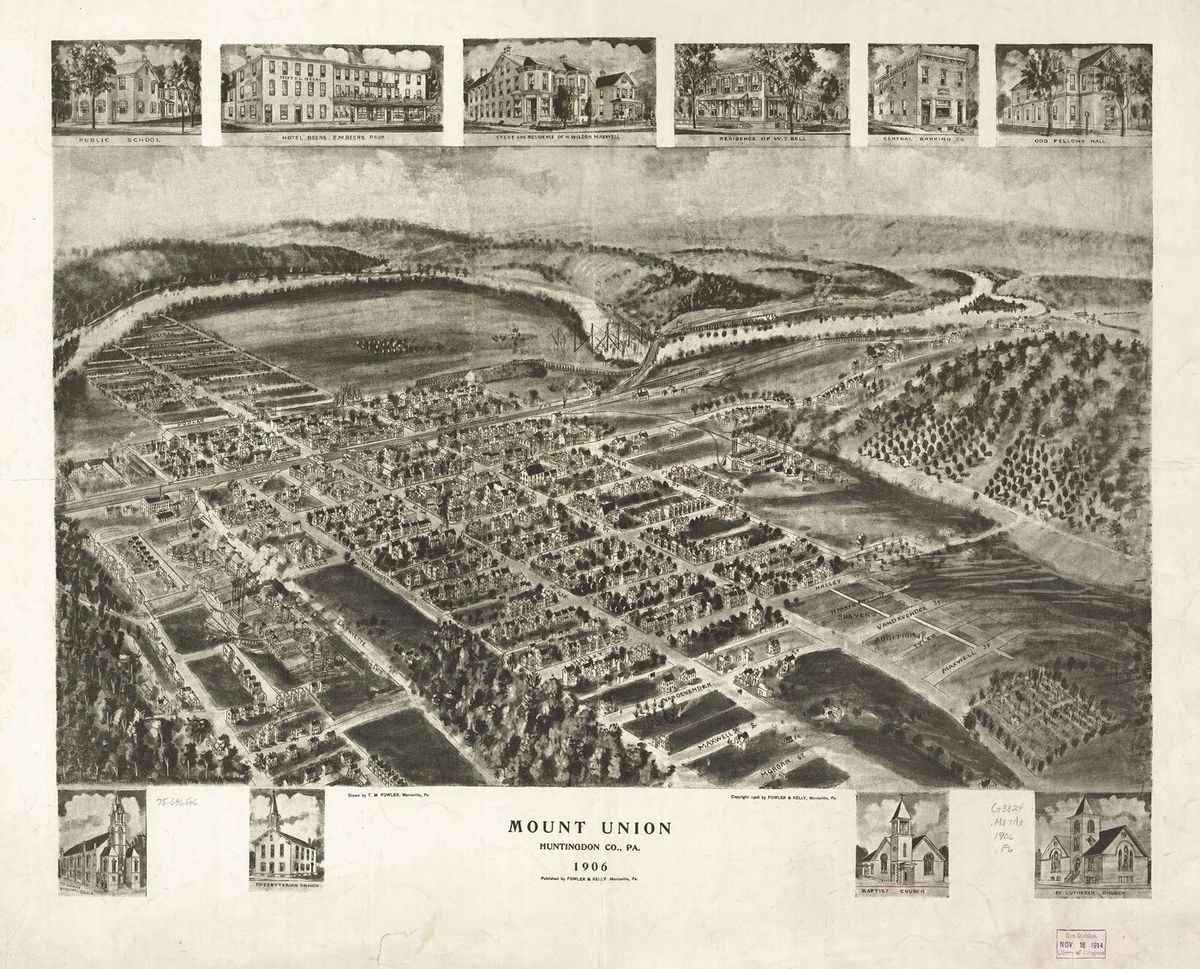
- Charles H. Welch, History of Mount Union, Shirleysburg and Shirley Township, 1909, pages 736 to 739: where Armstrong is buried, and a retelling of the account
- Mapleton Centennial 1866 to 1966, 1966, unnumbered page: Armstrong's resting place, reprinted with a changed location
- Milton Scott Lytle, History of Huntingdon County, 1876, pp. 25 and 33: Harris's distances to the Narrows and Armstrong's burial with no place named
- J. Simpson Africa, History of Huntingdon and Blair Counties, 1883, p. 11: the Delaware reply on Armstrong's burial
Checked 2026-11-01 · Primary sources and the Pennsylvania Newspaper Archive
← All stories from Brady township
Have something to add to this story, or a photograph of it? Send it here →
Photographs from Brady township
More from Brady township
The Mapleton centennial book of 1966 says Marion Samuel Cree, a native of the town, spent the last 17 years of his life…
Mapleton borough, The Flea Bite at Newton HamiltonOn Christmas Day 1879, B. E. Morrison began a four-page newspaper in Newton Hamilton. The 1886 history of the…
Mapleton borough, The Clairndon Hotel at MapletonThe Clairndon Hotel stood in the center of Mapleton. The town's 1966 centennial book says it was built about 1905, and…
Also about County history
Before he wrote his history of Mount Union, Charles Howard Welch brought out a book of poems. The title page reads A…
elsewhere in the county, A Police Escort Home From WildwoodIn March 2015 the Huntingdon Daily News told readers about Darkhorse Percussion, an independent indoor percussion group…